
Thủ Thuật
  • TOP Thủ Thuật
    • Thủ Thuật Internet
    • Thủ Thuật Máy Tính
    • Thủ Thuật Tiện Ích
    • Thủ Thuật Phần Mềm
  • Chia Sẻ Kiến Thức
    • Học Excel
    • Học Word
    • Học Power Point
  • Games
  • Kênh Công Nghệ
  • Facebook
  • WordPress
  • SEO
No Result
View All Result
Thủ Thuật
  • TOP Thủ Thuật
    • Thủ Thuật Internet
    • Thủ Thuật Máy Tính
    • Thủ Thuật Tiện Ích
    • Thủ Thuật Phần Mềm
  • Chia Sẻ Kiến Thức
    • Học Excel
    • Học Word
    • Học Power Point
  • Games
  • Kênh Công Nghệ
  • Facebook
  • WordPress
  • SEO
No Result
View All Result
Thủ Thuật
No Result
View All Result
Home Chia Sẻ Kiến Thức Học Excel

Master Excel Formulas: A Comprehensive Guide to Syntax, Arguments, and Data Types

Master Excel Formulas: A Comprehensive Guide to Syntax, Arguments, and Data Types
6k
SHARES
19.5k
VIEWS
Share on Facebook

Nội Dung Bài Viết

Toggle
  • 1. The Anatomy of a Function: Understanding Syntax
  • 2. Mastering Input Values: Precision in Arguments
    • Direct vs. Indirect Input Methods
  • 3. The Hidden Trap: Data Types
    • Understanding Data Classifications
    • The Text vs. Number Conflict
  • Conclusion
  • References

Microsoft Excel is a powerhouse tool equipped with hundreds of functions designed to handle diverse computational needs. From simple arithmetic to complex data analysis, functions are the backbone of spreadsheet efficiency. However, knowing that a function exists is only half the battle; knowing how to construct it correctly is where the real challenge lies.

Many users struggle with frustrating error messages like #N/A, #VALUE!, or #REF! simply because they overlook the fundamental mechanics of formula writing. To transition from a novice user to an Excel proficient, you must master the three core pillars of function construction: Syntax, Input Values, and Data Types.

1. The Anatomy of a Function: Understanding Syntax

Every function in Excel operates like a sentence in a language; it requires a specific structure, or syntax, to convey meaning. If the grammar is wrong, Excel cannot process the request. Understanding this structure is the first step toward error-free calculations.

When you begin typing a function (e.g., =VLOOKUP), Excel provides a tooltip showing the required syntax. Let’s dissect the VLOOKUP function, a staple in data management, to understand this concept better.

The standard syntax is:
=VLOOKUP(lookup_value, table_array, col_index_num, [range_lookup])

Structure of VLOOKUP function in Excel highlighting its four argumentsStructure of VLOOKUP function in Excel highlighting its four arguments

Breaking down these components reveals the logic behind the code:

  • lookup_value: The anchor point. This is the value you want to search for in your dataset.
  • table_array: The map. This is the range of cells or the table containing the data you want to retrieve.
  • col_index_num: The coordinate. This represents the column number in the table from which to retrieve the value.
  • [range_lookup]: The precision setting. This optional argument determines whether you want an exact match or an approximate one.

Animation explaining the different components of the VLOOKUP function in ExcelAnimation explaining the different components of the VLOOKUP function in Excel

One of the most critical parts of syntax is the range_lookup. Although optional (denoted by brackets []), ignoring it often leads to incorrect data retrieval.

  • TRUE (or 1/Omitted): Performs an approximate match. Use this for tiered values like tax brackets or grading scales.
  • FALSE (or 0): Performs an exact match. This is essential for unique identifiers like ID numbers or product codes.
Xem thêm:  Hướng Dẫn Tạo Nút Chọn Thư Mục Trong Excel Bằng VBA

Guide to using the range_lookup parameter in VLOOKUP with True and False optionsGuide to using the range_lookup parameter in VLOOKUP with True and False options

Strict adherence to syntax ensures that Excel interprets your logic exactly as intended. A missing comma or a misplaced parenthesis is often the culprit behind a broken formula.

2. Mastering Input Values: Precision in Arguments

Once the syntax structure is in place, the next step is ensuring the input values (arguments) within that structure are valid and logical.

Each argument has specific constraints. For instance, in VLOOKUP, the col_index_num requires a positive integer.

  • Logical Constraints: The column index number must correspond to the size of your table_array. If your selected table has 5 columns, you cannot request data from column 6. Doing so will result in a #REF! error.
  • Format Constraints: This argument expects a number. Typing a text string like “Three” instead of the number 3 will cause the formula to fail immediately.

Direct vs. Indirect Input Methods

Excel offers flexibility in how you provide these values. You can either hardcode them or use dynamic referencing.

  1. Direct Input (Hardcoding): You manually type the value into the formula (e.g., =SUM(A1, 10)). This is static and won’t change unless you edit the formula.
  2. Indirect Input (Cell Referencing): You refer to a cell that contains the value (e.g., =SUM(A1, B1)). This is dynamic; changing the value in cell B1 automatically updates the result.

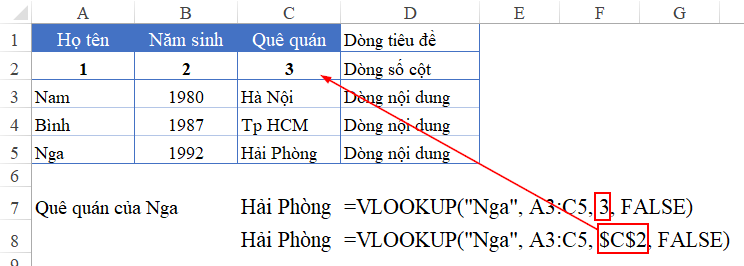
Methods for writing cell references and direct values in Excel formulasMethods for writing cell references and direct values in Excel formulas

In the example above, both formulas yield the same result, but the approach differs:

  • Formula 1: Uses the number 3 directly.
  • Formula 2: References cell C2 (which contains 3).

Professional Excel users prefer Indirect Input (referencing). It allows for scalable and automated spreadsheets where users can change input cells without risking damage to complex formulas.

When inputting values, keep these formatting rules in mind:

  • Text: Must be enclosed in double quotes (e.g., "Vietnam").
  • Numbers: Should be typed without quotes (e.g., 100).
  • Booleans: TRUE and FALSE are recognized keywords and do not need quotes.
Xem thêm:  Cách Xoay Chiều Trang Word: Từ Dọc Sang Ngang và Ngược Lại

3. The Hidden Trap: Data Types

The third and perhaps most subtle cause of Excel errors is Data Type Mismatch. Excel treats Text, Numbers, and Dates differently, even if they look identical to the human eye.

Understanding Data Classifications

  • Primitive Types:
    • Text: Any sequence of characters. Note that a number stored as text (e.g., "123") is mathematically useless until converted.
    • Number: Values that can be calculated.
    • Date/Time: In Excel, these are actually serial numbers formatted to look like dates.
  • Reference Types:
    • Range: A collection of cells (e.g., A1:A10).
    • Array: A set of data values (e.g., {1, 2, 3}).

Certain functions demand specific data types. SUMIF requires a Range for its criteria check, whereas VLOOKUP processes a Table Array.

The Text vs. Number Conflict

A classic scenario involves VLOOKUP failing because of a mismatch between the lookup value and the table data.

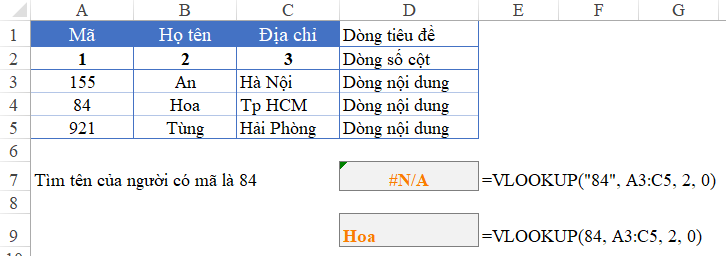
VLOOKUP error caused by data type mismatch between text and number formatsVLOOKUP error caused by data type mismatch between text and number formats

In the image above, the formula returns an error. Why?

  • The lookup_value is "84" (enclosed in quotes), which designates it as Text.
  • The Code column in the table contains the number 84, which is a Number.

To Excel, "84" (Text) is not equal to 84 (Number). Consequently, VLOOKUP cannot find a match. This often happens when importing data from external software where numbers are accidentally formatted as text.

Pro Tip: If you see a small green triangle in the corner of a cell, Excel is warning you that a number is stored as text. You can fix this by using the VALUE() function or using “Text to Columns” to convert the data.

Conclusion

Writing effective Excel formulas is not just about memorizing function names; it requires a disciplined approach to structure and data management. When your formula returns an error, do not panic. Instead, perform a systematic check:

  1. Check Syntax: Are commas and parentheses in the right place?
  2. Check Arguments: Are the input values logical and within valid ranges?
  3. Check Data Types: Are you comparing numbers with text?

By mastering these three elements—Syntax, Arguments, and Data Types—you will significantly reduce errors and unlock the full analytical potential of Excel.

References

  • Microsoft Support. (n.d.). VLOOKUP function. Retrieved from Microsoft.com
  • ExcelJet. (n.d.). Excel Formula Syntax. Retrieved from ExcelJet.net
  • Spreadsheeto. (n.d.). Data Types in Excel. Retrieved from Spreadsheeto.com
Đánh Giá Bài Viết
Tuyết Nhi

Tuyết Nhi

Tôi là Tuyết Nhi - Nữ phóng viên trẻ đến từ Hà Nội. Với niềm đam mê công nghệ, khoa học kỹ thuật, tôi yêu thích và muốn chia sẻ đến mọi người những trải nghiệm, kinh nghiệm về các lĩnh vực công nghệ, kỹ thuật... Rất mong được quý độc giả đón nhận ❤️.

Related Posts

How to Generate Unique Random Numbers in Excel: A Comprehensive Guide
Học Excel

How to Generate Unique Random Numbers in Excel: A Comprehensive Guide

Master the Excel ERROR.TYPE Function to Categorize and Fix Formula Errors
Học Excel

Master the Excel ERROR.TYPE Function to Categorize and Fix Formula Errors

How to Print A5 Pages on A4 Paper: A Complete Guide
Học Excel

How to Print A5 Pages on A4 Paper: A Complete Guide

How to Create a Professional Plan vs. Actual Chart in Excel
Học Excel

How to Create a Professional Plan vs. Actual Chart in Excel

Discussion about this post

Trending.

Trích Xuất Dữ Liệu từ Báo Cáo Power BI Đã Xuất Bản Trên Web

Trích Xuất Dữ Liệu từ Báo Cáo Power BI Đã Xuất Bản Trên Web

Hướng Dẫn Cách Livestream Trên Facebook Bằng Điện Thoại Và Máy Tính Đơn Giản, Sắc Nét Từ A-Z

Hướng Dẫn Cách Livestream Trên Facebook Bằng Điện Thoại Và Máy Tính Đơn Giản, Sắc Nét Từ A-Z

World War 2: Strategy Games – Game Chiến Thuật Thế Chiến II Hấp Dẫn Trên Mobile

World War 2: Strategy Games – Game Chiến Thuật Thế Chiến II Hấp Dẫn Trên Mobile

Download Your Uninstaller Pro 7.5 Full Key 2025 – Giải Pháp Gỡ Cài Đặt Phần Mềm Tận Gốc

Download Your Uninstaller Pro 7.5 Full Key 2025 – Giải Pháp Gỡ Cài Đặt Phần Mềm Tận Gốc

Hướng Dẫn Tích Hợp Akismet Vào Contact Form 7: Giải Pháp Chống Spam “Tàng Hình” Hiệu Quả Nhất

Hướng Dẫn Tích Hợp Akismet Vào Contact Form 7: Giải Pháp Chống Spam “Tàng Hình” Hiệu Quả Nhất

Giới Thiệu

Thủ Thuật

➤ Website đang trong quá trình thử nghiệm AI biên tập, mọi nội dung trên website chúng tôi không chịu trách nhiệm. Bạn hãy cân nhắc thêm khi tham khảo bài viết, xin cảm ơn!

Chuyên Mục

➤ TOP Thủ Thuật

➤ Chia Sẻ Kiến Thức

➤ Kênh Công Nghệ

➤ SEO

➤ Games

Liên Kết

➤ Ketquaxskt.com

➤ TOP Restaurants

➤ Here Restaurant

➤

➤

Liên Hệ

➤ TP. Hải Phòng, Việt Nam

➤ 0931. 910. JQK

➤ Email: [email protected]

Website này cũng cần quảng cáo, không có tiền thì viết bài làm sao  ” Đen Vâu – MTP ”

DMCA.com Protection Status

© 2025 Thủ Thuật - Website chia sẻ kiến thức công nghệ hàng đầu Việt Nam

No Result
View All Result
  • TOP Thủ Thuật
    • Thủ Thuật Internet
    • Thủ Thuật Máy Tính
    • Thủ Thuật Tiện Ích
    • Thủ Thuật Phần Mềm
  • Chia Sẻ Kiến Thức
    • Học Excel
    • Học Word
    • Học Power Point
  • Games
  • Kênh Công Nghệ
  • Facebook
  • WordPress
  • SEO

© 2025 Thủ Thuật - Website chia sẻ kiến thức công nghệ hàng đầu Việt Nam