
Have you ever spent hours perfecting a complex spreadsheet, only to watch your formulas break the moment you copy them to a new location? This is a classic frustration for data analysts and office professionals alike. By default, Excel uses relative references, meaning it adjusts cell addresses based on the new location of the formula (e.g., moving =A1*2 one cell down changes it to =A2*2). While this feature is usually helpful for applying calculations across rows, it becomes a nightmare when you need to duplicate exact formulas to a different sheet or a distant part of your workbook.
At Thủ Thuật, we understand that data integrity is paramount. In this comprehensive guide, we will explore the technical nuances of Excel referencing and provide you with proven solutions—ranging from quick keyboard shortcuts to advanced bulk-processing techniques—to copy formulas without altering their cell references.
The Mechanics of Copying a Single Formula
If you only need to move or duplicate a single cell’s formula while maintaining its exact references, you don’t need complex workarounds. Excel provides built-in methods to treat the formula as a text string rather than a positional instruction.
Method 1: The Formula Bar Technique
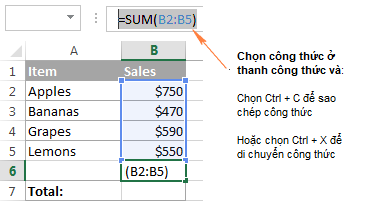
The most reliable way to copy a single formula without Excel adjusting the references is to copy the text of the formula rather than the cell itself.
- Select the source cell containing the formula you wish to copy.
- Move your cursor to the Formula Bar at the top of the sheet.
- Highlight the entire formula string (including the
=sign). - Press
Ctrl + Cto copy (orCtrl + Xif you intend to move it entirely).
User highlighting a formula in the Excel formula bar to copy it
- Crucial Step: Press
Escto exit the Formula Bar. If you click away without pressing Esc, you might accidentally alter the formula. - Navigate to your destination cell (on the same sheet or a different one).
- Press
Ctrl + Vto paste. Because you copied the text string, Excel pastes it exactly as written, preserving the original references.
Method 2: In-Cell Editing Mode
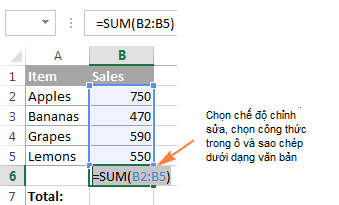
Similar to the Formula Bar method, you can perform this action directly within the cell grid. This is particularly faster if you prefer keeping your eyes on the data table.
- Select the cell containing the formula.
- Press
F2or double-click the cell to enter Edit Mode. - Highlight the formula text within the cell.
- Press
Ctrl + Cto copy.
Selecting text within a cell while in edit mode in Excel
- Press
Escto exit Edit Mode. - Select the destination cell and paste (
Ctrl + V). The formula will appear exactly as it was in the original cell.
Pro Tip: The Ctrl + ' Shortcut
For immediate duplication, Excel offers a hidden shortcut that is highly efficient for data entry. If you want to copy the formula from the cell directly above the active cell without changing its references:
- Select the cell immediately below the formula you want to copy.
- Press
Ctrl + '(Control + Apostrophe).
Animation showing the Ctrl plus apostrophe shortcut to duplicate the cell above
This command instructs Excel to “copy the formula from the above cell exactly as is,” bypassing the relative reference logic entirely.
Advanced Techniques for Copying Ranges of Formulas
Copying one cell is easy, but what if you need to migrate a massive table of calculations? Doing this cell-by-cell is inefficient. Below are professional methods to handle bulk data while maintaining data integrity.
1. Mastering Absolute and Mixed References
The most “Excel-native” way to prevent references from changing is to lock them before you copy. This involves changing Relative References (e.g., A1) to Absolute References (e.g., $A$1) or Mixed References (e.g., $A1 or A$1).
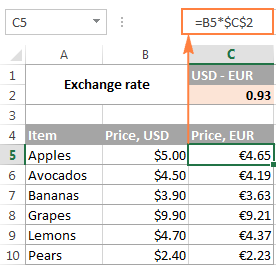
Scenario: Imagine you are calculating the price of fruits in Euros based on a USD price list (Column B) and a fixed Exchange Rate located in cell C2.
Excel spreadsheet showing fruit prices in USD and a fixed exchange rate cell
If you write =B5*C2 and drag it down, C2 will change to C3, C4, etc., resulting in errors because the exchange rate is only in C2. Furthermore, if you copy this formula to a new column to simulate a different scenario, the B5 (Price) reference might shift to C5 or D5, breaking the logic.
The Solution:
Use the dollar sign ($) to lock specific parts of the reference:
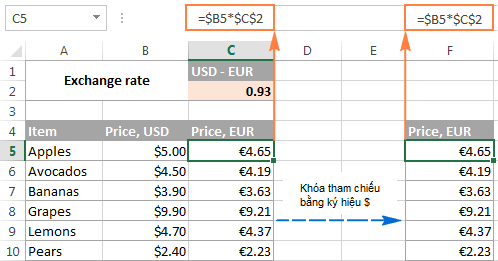
- $C$2: Locks both column and row. The exchange rate reference will never move, no matter where you copy the formula.
- $B5: Locks the column (B) but allows the row to change. This is crucial if you move the formula to Column F but still want it to reference the original prices in Column B.
Using mixed references with dollar signs to lock column B
By converting your formula to =$B5*$C$2 before copying, you ensure that the references remain pointing to the correct data, regardless of where the formula ends up.
2. The Notepad “Text Bridge” Method
If you don’t want to add dollar signs to every formula just to move them, you can use a text editor like Notepad as a bridge. This strips away Excel’s “smart” clipboard functionality.
Step-by-Step Guide:
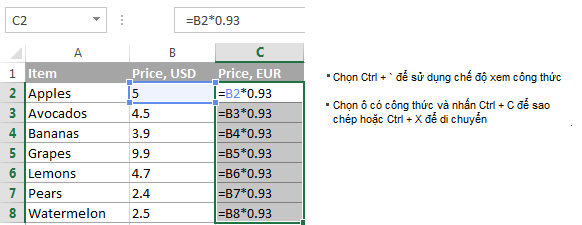
- In Excel, press
Ctrl + ~(tilde) or go to the Formulas tab and select Show Formulas. This reveals the underlying code instead of the results. - Select the range of cells containing the formulas.
- Press
Ctrl + Cto copy.
Excel sheet in Show Formulas mode displaying equations instead of results
- Open Notepad (or any plain text editor).
- Press
Ctrl + Vto paste. You will see the formulas purely as text. - Press
Ctrl + A(Select All) in Notepad, thenCtrl + Cto copy. - Return to Excel and select your destination cell (this can be on a different sheet).
- Press
Ctrl + Vto paste. - Finally, turn off Show Formulas by pressing
Ctrl + ~again.
Note: This method works best when pasting into the same sheet or a sheet with identical structure. If your formulas reference other sheets (e.g., Sheet1!A1), those references remain static.
3. The “Find and Replace” Hack
This is a favorite trick among power users for moving large blocks of formulas without changing references and without leaving Excel. The logic is to temporarily convert formulas into text strings by removing the equals (=) sign.
Execution:
- Select the range of cells with formulas you want to move.
- Press
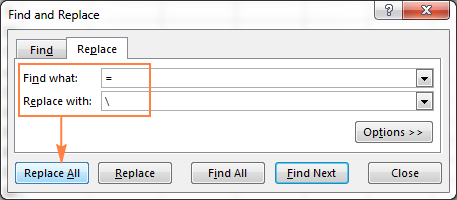
Ctrl + Hto open the Find and Replace dialog. - In the “Find what” field, type
=. - In the “Replace with” field, type a unique character that isn’t used in your data, such as
~or#.
Find and Replace dialog box substituting the equal sign with a tilde
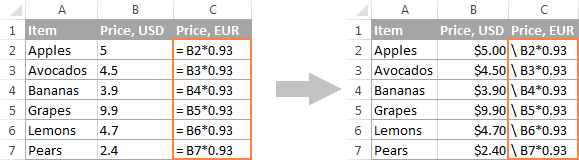
- Click Replace All. Your formulas will instantly turn into text strings (e.g.,
~SUM(A1:A10)). - Now, copy (
Ctrl + C) and paste (Ctrl + V) this “text” to your desired location. Since it’s just text, Excel won’t change the references.
Excel cells showing formulas treated as plain text strings starting with a tilde
- Once the data is in the new location, select the new range.
- Open Find and Replace (
Ctrl + H) again. - Reverse the process: Find
~(or your chosen character) and Replace with=. - Click Replace All. The text strings will convert back into active formulas with their original references intact.
Conclusion
Mastering cell references is a fundamental skill that separates casual Excel users from experts. Whether you are building financial models, engineering spreadsheets, or simple inventory lists, knowing how to manipulate references ensures your data remains accurate during restructuring.
- For single cells: Use the Formula Bar or
F2Edit Mode. - For calculated references: Use Absolute (
$) Referencing to lock logical data points. - For bulk moves: Utilize the Notepad trick or the Find & Replace hack to bypass Excel’s relative positioning engine.
By applying these techniques, you can restructure your workbooks freely without the fear of #REF! errors or incorrect calculations. At Thủ Thuật, we encourage you to experiment with these tools—along with other powerful features like SUMIFS, INDEX+MATCH, and Pivot Tables—to maximize your productivity.
References
- Microsoft Support. (n.d.). Switch between relative, absolute, and mixed references.
- ExcelJet. (n.d.). How to copy formulas without changing references.
- TechRepublic. (2023). Microsoft Excel: Tips and tricks for power users.


Discussion about this post