
Thủ Thuật
  • TOP Thủ Thuật
    • Thủ Thuật Internet
    • Thủ Thuật Máy Tính
    • Thủ Thuật Tiện Ích
    • Thủ Thuật Phần Mềm
  • Chia Sẻ Kiến Thức
    • Học Excel
    • Học Word
    • Học Power Point
  • Games
  • Kênh Công Nghệ
  • Facebook
  • WordPress
  • SEO
No Result
View All Result
Thủ Thuật
  • TOP Thủ Thuật
    • Thủ Thuật Internet
    • Thủ Thuật Máy Tính
    • Thủ Thuật Tiện Ích
    • Thủ Thuật Phần Mềm
  • Chia Sẻ Kiến Thức
    • Học Excel
    • Học Word
    • Học Power Point
  • Games
  • Kênh Công Nghệ
  • Facebook
  • WordPress
  • SEO
No Result
View All Result
Thủ Thuật
No Result
View All Result
Home Chia Sẻ Kiến Thức Học Excel

Master Excel Pivot Tables: A Comprehensive Guide to Analyzing Sales Data

Master Excel Pivot Tables: A Comprehensive Guide to Analyzing Sales Data
6k
SHARES
19.5k
VIEWS
Share on Facebook

Nội Dung Bài Viết

Toggle
  • Step 1: Preparing and Selecting Your Data
  • Step 2: Inserting the Pivot Table
  • Step 3: Configuring the Pivot Table Location
  • Step 4: Mapping Fields to Areas
  • Step 5: Analyzing and Grouping Time Data
  • Step 6: Formatting Financial Data
  • Step 7: utilizing Report Filters
  • Conclusion
  • References

In the world of data analysis, raw numbers often tell a confusing story. For professionals and business owners, the ability to transform a massive list of transactions into clear, actionable insights is a critical skill. This is where Excel Pivot Tables come into play. As one of the most powerful features in Microsoft Excel (available from version 2007 through Excel 365), Pivot Tables allow users to summarize, analyze, explore, and present summary data with just a few clicks.

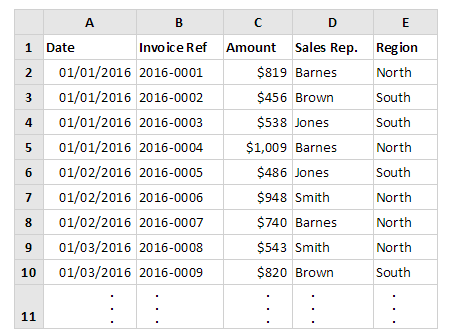
In this advanced tutorial, we will walk through the process of creating a dynamic sales report. We will use a dataset from the first quarter of 2016, which includes specific details such as Date, Invoice Reference, Amount, Sales Representative, and Region.

Raw sales data spreadsheet showing columns for Date, Invoice Ref, Amount, Sales Rep, and RegionRaw sales data spreadsheet showing columns for Date, Invoice Ref, Amount, Sales Rep, and Region

By the end of this guide, you will know how to construct a report that displays total revenue by month, segmented by region and sales personnel, turning a flat spreadsheet into a multidimensional analysis tool.

Step 1: Preparing and Selecting Your Data

Before initializing a Pivot Table, ensuring your data is clean is essential. This means no blank rows within the dataset and consistent headers for every column. Once your data is ready, click on any single cell within your data range. Alternatively, you can highlight the entire table manually.

Excel is smart enough to detect the contiguous range of data surrounding the active cell, which saves time when working with thousands of rows.

Step 2: Inserting the Pivot Table

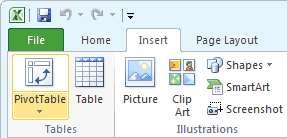
Navigate to the Insert tab located on the top ribbon of the Excel interface. In the “Tables” group on the far left, you will see the PivotTable button.

The Insert tab in Excel ribbon highlighting the PivotTable buttonThe Insert tab in Excel ribbon highlighting the PivotTable button

Clicking this button triggers the setup wizard. This is the gateway to moving from static data to dynamic analysis.

Xem thêm:  Convertio Review: How to Convert Images and PDFs to Word & Excel with High Accuracy

Step 3: Configuring the Pivot Table Location

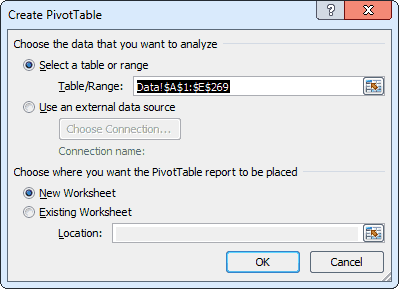
After clicking the button, the Create PivotTable dialog box will appear. Here, you need to verify two things:

  1. Select a table or range: Ensure Excel has correctly identified your data source (e.g., $A$1:$E$100).
  2. Choose where you want the PivotTable report to be placed: You can place it on the existing worksheet or a New Worksheet.

For a clean workspace, we highly recommend selecting “New Worksheet.” Once verified, click OK.

The Create PivotTable dialog box showing data range selection and location optionsThe Create PivotTable dialog box showing data range selection and location options

The system will now generate a placeholder for your report. If you are new to this process, visualizing the workflow can be helpful. The animation below demonstrates the seamless transition from raw data to the Pivot Table canvas.

Animated GIF demonstrating the process of creating a Pivot Table from a datasetAnimated GIF demonstrating the process of creating a Pivot Table from a dataset

Step 4: Mapping Fields to Areas

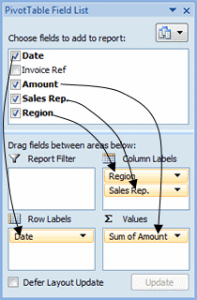
Once the Pivot Table is created, you will see a blank report area on the left and the PivotTable Field List pane on the right. This pane contains the headers from your source data. To build the report, you must drag and drop these fields into one of four areas: Filters, Columns, Rows, and Values.

For our specific sales report, follow this mapping strategy:

  • Rows: Drag the “Date” field here. This creates the vertical timeline of your report.
  • Values: Drag the “Amount” field here. Excel will automatically sum up the revenue.
  • Columns: Drag both “Region” and “Sales Rep.” here. This creates a matrix where you can compare performance across different areas and employees.

The PivotTable Field List showing fields being dragged into Row, Column, and Value areasThe PivotTable Field List showing fields being dragged into Row, Column, and Value areas

Step 5: Analyzing and Grouping Time Data

Initially, your Pivot Table might look overwhelming. Because we dragged the “Date” field into the Rows area, Excel lists every single unique date from the dataset. While accurate, a daily breakdown is often too granular for high-level trend analysis.

Initial Pivot Table view showing daily revenue figures without groupingInitial Pivot Table view showing daily revenue figures without grouping

To fix this, we utilize the Grouping feature. This allows us to aggregate daily data into months, quarters, or years.

  1. Right-click on any date inside the Row Labels column (the left-most column of the Pivot Table).
  2. Select Group… from the context menu.
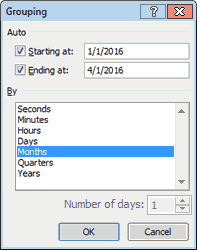
  3. In the “Grouping” dialog box, deselect other options and highlight Months.
Xem thêm:  Tra cứu Lịch Âm Dương trong Excel

The Grouping dialog box with the Months option selectedThe Grouping dialog box with the Months option selected

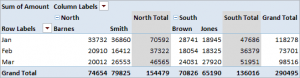
Upon clicking OK, the report instantly transforms. The hundreds of daily rows are condensed into neat, monthly summaries (January, February, March), providing a much clearer picture of sales performance over time.

Pivot Table displaying sales revenue aggregated by monthPivot Table displaying sales revenue aggregated by month

Step 6: Formatting Financial Data

A professional report must be readable. By default, Excel may display numbers as general text (e.g., “15000” instead of “$15,000”). To enhance readability, select the columns containing revenue figures.

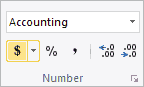
Go to the Home tab, locate the Number group, and click the currency symbol (or use the Accounting Number Format). This adds currency symbols and comma separators, making the data easier to scan.

Pivot Table with currency formatting applied to the revenue columnsPivot Table with currency formatting applied to the revenue columns

Step 7: utilizing Report Filters

Sometimes, you need to focus on a specific segment of your data without altering the entire structure of the table. This is where the Report Filter (or simply “Filters” in newer Excel versions) becomes invaluable.

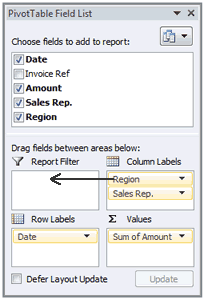
Let’s say management wants to see a report specifically for the “North” region. To do this, drag the “Region” field from the Columns area (or the field list) into the Report Filter area.

Dragging the Region field into the Report Filter area of the Field ListDragging the Region field into the Report Filter area of the Field List

The “Region” field will now appear at the very top of your Pivot Table, separated from the main data grid. Click the dropdown arrow next to it, select “North”, and click OK. The entire table will update to reflect revenue generated only in the Northern region.

Pivot Table displaying data filtered specifically for the North regionPivot Table displaying data filtered specifically for the North region

Conclusion

Mastering Pivot Tables is a game-changer for anyone working with data. In this guide, we successfully transformed a raw list of sales transactions into a structured, formatted, and interactive report. We covered selecting data, mapping fields, grouping dates by month, and using filters to isolate specific information.

By applying these techniques, you can save hours of manual calculation and gain deeper insights into your business metrics. We encourage you to experiment with different field arrangements to discover new perspectives on your data.

References

  • Microsoft Support: Create a PivotTable to analyze worksheet data.
  • TechCommunity: Advanced grouping techniques for Excel data analysis.
  • ExcelJet: Pivot Table layout and formatting tips.
Đánh Giá Bài Viết
Tuyết Nhi

Tuyết Nhi

Tôi là Tuyết Nhi - Nữ phóng viên trẻ đến từ Hà Nội. Với niềm đam mê công nghệ, khoa học kỹ thuật, tôi yêu thích và muốn chia sẻ đến mọi người những trải nghiệm, kinh nghiệm về các lĩnh vực công nghệ, kỹ thuật... Rất mong được quý độc giả đón nhận ❤️.

Related Posts

How to Generate Unique Random Numbers in Excel: A Comprehensive Guide
Học Excel

How to Generate Unique Random Numbers in Excel: A Comprehensive Guide

Master the Excel ERROR.TYPE Function to Categorize and Fix Formula Errors
Học Excel

Master the Excel ERROR.TYPE Function to Categorize and Fix Formula Errors

How to Print A5 Pages on A4 Paper: A Complete Guide
Học Excel

How to Print A5 Pages on A4 Paper: A Complete Guide

How to Create a Professional Plan vs. Actual Chart in Excel
Học Excel

How to Create a Professional Plan vs. Actual Chart in Excel

Discussion about this post

Trending.

Hướng Dẫn Tích Hợp Akismet Vào Contact Form 7: Giải Pháp Chống Spam “Tàng Hình” Hiệu Quả Nhất

Hướng Dẫn Tích Hợp Akismet Vào Contact Form 7: Giải Pháp Chống Spam “Tàng Hình” Hiệu Quả Nhất

Trích Xuất Dữ Liệu từ Báo Cáo Power BI Đã Xuất Bản Trên Web

Trích Xuất Dữ Liệu từ Báo Cáo Power BI Đã Xuất Bản Trên Web

Hướng Dẫn Cách Livestream Trên Facebook Bằng Điện Thoại Và Máy Tính Đơn Giản, Sắc Nét Từ A-Z

Hướng Dẫn Cách Livestream Trên Facebook Bằng Điện Thoại Và Máy Tính Đơn Giản, Sắc Nét Từ A-Z

World War 2: Strategy Games – Game Chiến Thuật Thế Chiến II Hấp Dẫn Trên Mobile

World War 2: Strategy Games – Game Chiến Thuật Thế Chiến II Hấp Dẫn Trên Mobile

Share Acc The Battle Cats Miễn Phí Mới Nhất 2025: Full Uber Rare & Cat Food

Share Acc The Battle Cats Miễn Phí Mới Nhất 2025: Full Uber Rare & Cat Food

Giới Thiệu

Thủ Thuật

➤ Website đang trong quá trình thử nghiệm AI biên tập, mọi nội dung trên website chúng tôi không chịu trách nhiệm. Bạn hãy cân nhắc thêm khi tham khảo bài viết, xin cảm ơn!

Chuyên Mục

➤ TOP Thủ Thuật

➤ Chia Sẻ Kiến Thức

➤ Kênh Công Nghệ

➤ SEO

➤ Games

Liên Kết

➤ Ketquaxskt.com

➤ TOP Restaurants

➤ Here Restaurant

➤

➤

Liên Hệ

➤ TP. Hải Phòng, Việt Nam

➤ 0931. 910. JQK

➤ Email: [email protected]

Website này cũng cần quảng cáo, không có tiền thì viết bài làm sao  ” Đen Vâu – MTP ”

DMCA.com Protection Status

© 2025 Thủ Thuật - Website chia sẻ kiến thức công nghệ hàng đầu Việt Nam

No Result
View All Result
  • TOP Thủ Thuật
    • Thủ Thuật Internet
    • Thủ Thuật Máy Tính
    • Thủ Thuật Tiện Ích
    • Thủ Thuật Phần Mềm
  • Chia Sẻ Kiến Thức
    • Học Excel
    • Học Word
    • Học Power Point
  • Games
  • Kênh Công Nghệ
  • Facebook
  • WordPress
  • SEO

© 2025 Thủ Thuật - Website chia sẻ kiến thức công nghệ hàng đầu Việt Nam