


One of the most common yet surprisingly tricky tasks in data management is generating a list of random numbers that do not repeat. While creating a simple list of numbers is elementary, ensuring the “uniqueness” of random elements poses a significant challenge for many Excel users. Whether you are assigning lottery numbers, shuffling teams, or selecting samples for an audit, duplicate values can ruin your dataset.
In this guide, we will explore the core problem of random number generation and provide robust solutions for both modern Office 365 users and those using legacy versions of Excel.
The Challenge: Randomness vs. Uniqueness
Let’s start by analyzing a specific, real-world scenario commonly faced by Excel users. Consider a requirement where a user needs to generate a list from 1 to 50, but specifically needs to extract 25 unique pairs from that range.
The request can be broken down into two distinct phases:
- Generation: Create a randomized pool of numbers from 1 to 50 without any duplicates.
- Formatting: Arrange these numbers into specific pairs (2 columns).
 Screenshot of a user request asking for 25 random pairs from 1 to 50 without duplicates
The difficulty lies in the fact that standard randomization functions in Excel (like RAND or RANDBETWEEN) operate independently on each cell. They do not “know” what number was generated in the adjacent cell, leading to inevitable repetitions.
Approach 1: The Sequential Method (Non-Random)
Before diving into complex formulas, it is worth noting the simplest way to get unique numbers: generating them in order. If randomness is not a strict requirement, but uniqueness is, you can simply create a list from 1 to 50 using the Fill Handle or the Sequence feature.
This ensures you have exactly one of each number. However, if you simply select pairs from this list top-to-bottom, the result is predictable (1-2, 3-4, etc.), which defeats the purpose of a “random draw.”
 Animation showing how to use the fill handle in Excel to create a sequence
You can create this base list quickly using the Fill Series feature or, in newer Excel versions, the =SEQUENCE(50) function. While this solves the “uniqueness” problem, it fails the “randomness” test. To make this useful, we need to introduce chaos into this order.
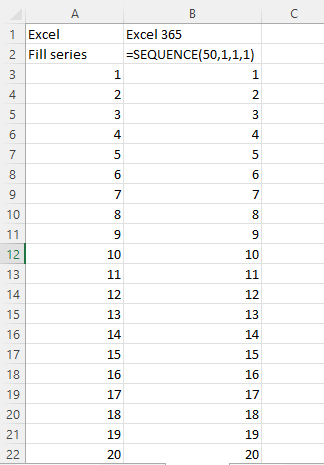 Excel sheet showing a sequential list of numbers from 1 to 50 in column A
Approach 2: The Modern Solution (Office 365)
If you are using Microsoft 365 (formerly Office 365), generating unique random numbers is incredibly efficient thanks to Dynamic Array functions. We can combine UNIQUE and RANDARRAY to solve this problem in a single step.
The Formula
The strategy here is to generate a pool of random numbers larger than we need, and then filter out the duplicates. Since RANDARRAY might generate duplicates, we generate a large list (e.g., 9999 numbers) to statistically guarantee that we will find at least 50 unique numbers in the range of 1 to 50.
Use the following formula:
=UNIQUE(RANDARRAY(9999,1,1,50,TRUE))How it works:
- RANDARRAY(9999,1,1,50,TRUE): Generates a column of 9,999 integers between 1 and 50.
- UNIQUE(…): filters this massive list and returns only the distinct values found, in the order they first appeared.
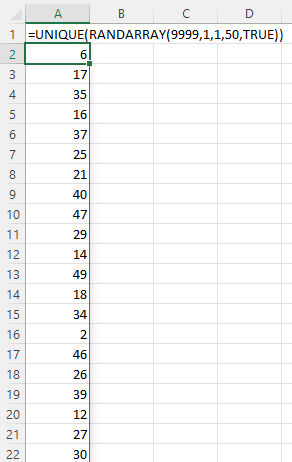 Excel spreadsheet demonstrating the SPILL result of the UNIQUE and RANDARRAY functions
This will return a spilled array of numbers 1 through 50 in a completely random order, with zero duplicates.
Approach 3: The Universal Solution (Legacy Excel)
For those using Excel 2010, 2013, 2016, or 2019, the Dynamic Array functions above are not available. We must rely on a logic-based workaround using “Helper Columns.”
The concept involves two steps:
- Generate a list of random numbers (which may have duplicates).
- Create a unique “Rank” for each number to sort them into a sequence from 1 to 50.
Step 1: Generate Random Seeds
First, in Column A, use the RANDBETWEEN function for 50 rows.
=RANDBETWEEN(1,50)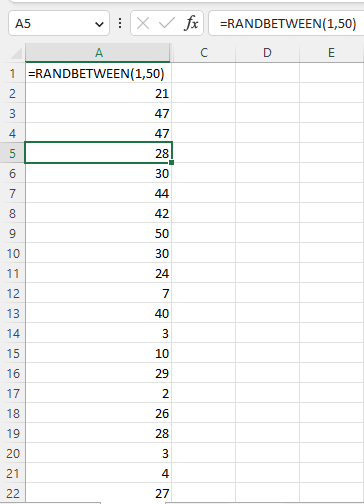 Column showing the RANDBETWEEN function generating numbers with potential duplicates
Note: You will likely see duplicate numbers in this list. This is expected and will be handled in the next step.
Step 2: Unique Ranking (The Tie-Breaker)
To create a unique list from 1 to 50 based on the random numbers in Column A, we use the RANK.EQ function combined with COUNTIFS. This technique essentially says: “Rank the numbers by size, and if two numbers are equal, the one that appears later in the list gets a higher rank.”
Enter this formula in Column B (Cell B2) and drag it down:
=RANK.EQ(A2,$A$2:$A$50)+COUNTIFS($A$2:A2,A2)-1Formula Breakdown:
- RANK.EQ(A2,$A$2:$A$50): Ranks the number in A2 against the whole list. If there are two instances of the number “5”, they will initially have the same rank.
- COUNTIFS($A$2:A2,A2)-1: Counts how many times the number in A2 has appeared so far in the list (cumulative count).
- For the first occurrence, the result is 0 (Rank + 0).
- For the second occurrence (duplicate), the result is 1 (Rank + 1).
This logic ensures that even if Column A has five instances of the number “10”, Column B will generate five unique ranking numbers for them.
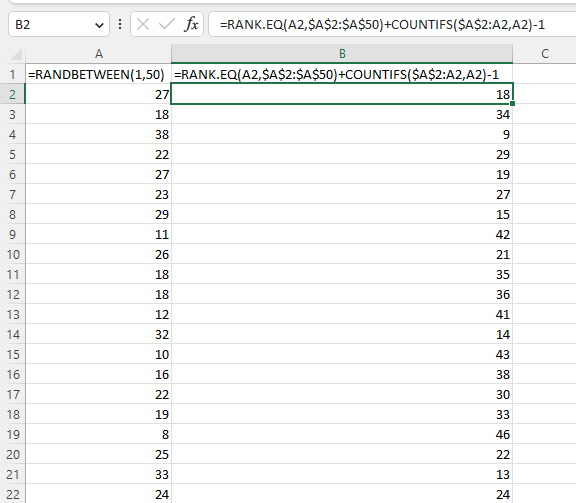 Excel table showing the RANK.EQ and COUNTIFS formula used to create unique rankings
Formatting the Data: Creating Pairs
Once you have a single column of unique random numbers (either from the Office 365 method or the Legacy Rank method), the final step is to format them into pairs as requested (25 rows, 2 columns).
Method A: Using WRAPROWS (Office 365)
If you are using the modern Excel version, you can instantly reshape your 1D array into a 2D grid using WRAPROWS or WRAPCOLS.
Assuming your random unique list is in the range B2:B50:
=WRAPROWS($B$2:$B$50, 2)This formula takes the data and wraps it into a new row after every 2 values, effectively creating pairs.
 Data formatted into two columns using the WRAPROWS function in Excel 365
Method B: Using INDEX and Mathematics (Universal)
If you lack the WRAPROWS function, you can achieve the exact same result using the INDEX function combined with row and column mathematics. This requires a bit of matrix logic.
Enter this formula into the cell where you want the first pair to start:
=INDEX($B$2:$B$50, ROW(A1) + (COLUMN(A1)-1)*2)The Logic:
- ROW(A1): Returns 1. As you drag down, it becomes 2, 3, etc.
- *(COLUMN(A1)-1)2:** This acts as a column offset.
- In the first column, it calculates to 0.
- In the second column, it calculates to 2.
- Result:
- Cell 1 (Row 1, Col 1): Index 1 + 0 = 1st item.
- Cell 2 (Row 1, Col 2): Index 1 + 2 = 3rd item (Wait, this logic skips items if not careful. The typical mapping for a 2-column wrap is usually
(ROW(A1)-1)*2 + COLUMN(A1)).
Correction based on standard INDEX wrapping: To fill a 2-column grid sequentially (Item 1 & 2 in row 1, Item 3 & 4 in row 2), the math is usually:
=INDEX(SourceList, (ROW(A1)-1)*2 + COLUMN(A1))
However, the specific formula used in the example image follows a specific vertical priority or specific pair logic. Let’s look at the result:
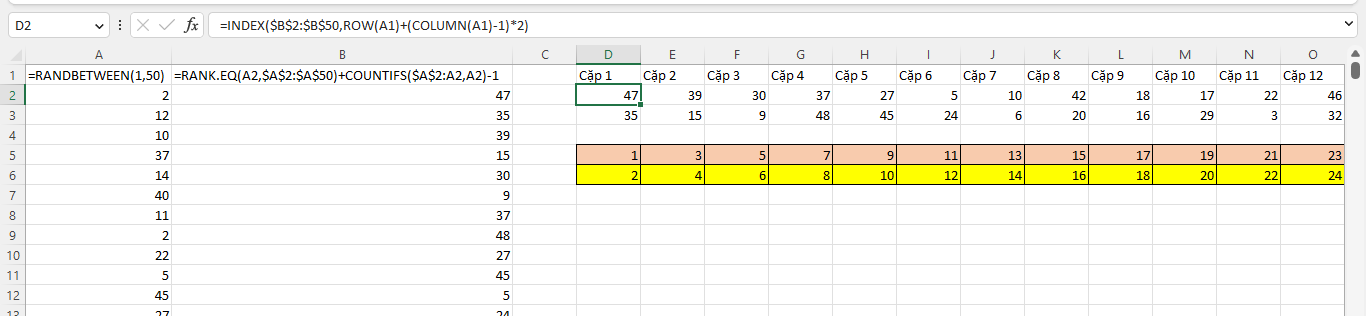 Using the INDEX function with row and column logic to map a single list into a 2D grid
By utilizing ROW and COLUMN as variables, you create a dynamic coordinate system that extracts values from your source list in the exact order you desire, without manual copying and pasting.
Conclusion
Generating a unique random number sequence in Excel transforms a seemingly simple task into a test of your knowledge of Excel functions.
- For Office 365 users: The combination of
UNIQUE,RANDARRAY, andWRAPROWSprovides a clean, formula-based solution that updates dynamically. - For Legacy users: The
RANK.EQ+COUNTIFSmethod is a timeless technique that guarantees uniqueness by mathematically distinguishing duplicates.
Mastering these techniques not only solves the immediate problem of random pairing but also deepens your understanding of array manipulation and logical ranking in Excel.
References
- Microsoft Support. “RANDARRAY function.” Microsoft.com.
- Microsoft Support. “UNIQUE function.” Microsoft.com.
- Excel Tech Community. “Generating non-repeating random integers.”
- Hoc Excel Online. “Techniques for Random Data Generation.”



![[Course Review] Building a Smart Production Management System with Google Sheets, Apps Script, and QR Codes](https://thuthuat.com.vn/wp-content/uploads/2025/04/khoa-hoc-quan-ly-san-xuat.png "[Course Review] Building a Smart Production Management System with Google Sheets, Apps Script, and QR Codes")






Discussion about this post