

![[Excel Tutorial] How to Build a Professional Shift and Overtime Timesheet](https://thuthuat.com.vn/wp-content/uploads/2025/04/cach-lap-bang-cham-cong-theo-ca-va-lam-them-gio-tren-Excel.jpg "[Excel Tutorial] How to Build a Professional Shift and Overtime Timesheet")
For large enterprises, particularly in the manufacturing and service sectors, human resource management is a complex operation. Tracking attendance involves more than just noting who showed up; it requires managing rotating shifts, calculating overtime (OT), and accounting for various leave types. While dedicated HR software exists, Microsoft Excel remains a powerful, flexible, and cost-effective tool for streamlining this process.
This guide will provide a technical walkthrough on constructing a dynamic shift and overtime timesheet in Excel, allowing HR managers and team leaders to automate calculations and reduce manual errors.
Understanding the Logic: Shift Work and Overtime
Before diving into the spreadsheet design, it is crucial to understand the data structure required for shift management. Unlike standard office hours (9-to-5), shift-based environments typically operate on a 24-hour cycle divided into segments.
A robust tracking system must accommodate the following variables:
- Multi-Shift Operations: A day is often split into 2 or 3 shifts (e.g., Morning, Afternoon, Night), each lasting 8 hours.
- Rotation: Employees may rotate shifts weekly or monthly.
- Overtime (OT): Hours worked beyond the assigned shift duration.
- Exclusivity: An employee typically works only one “official” shift per day, with any additional time recorded as OT.
Therefore, a standard timesheet must capture the specific date, the assigned shift, overtime hours within that shift, and leave status (Paid/Unpaid) to generate accurate payroll data at the end of the month.
Step 1: Designing the Master Layout
The foundation of an effective Excel tool is its layout. For a shift-based timesheet, a flat list is often insufficient. Instead, a matrix format is preferred where columns represent days of the month and rows represent specific data points for each employee.
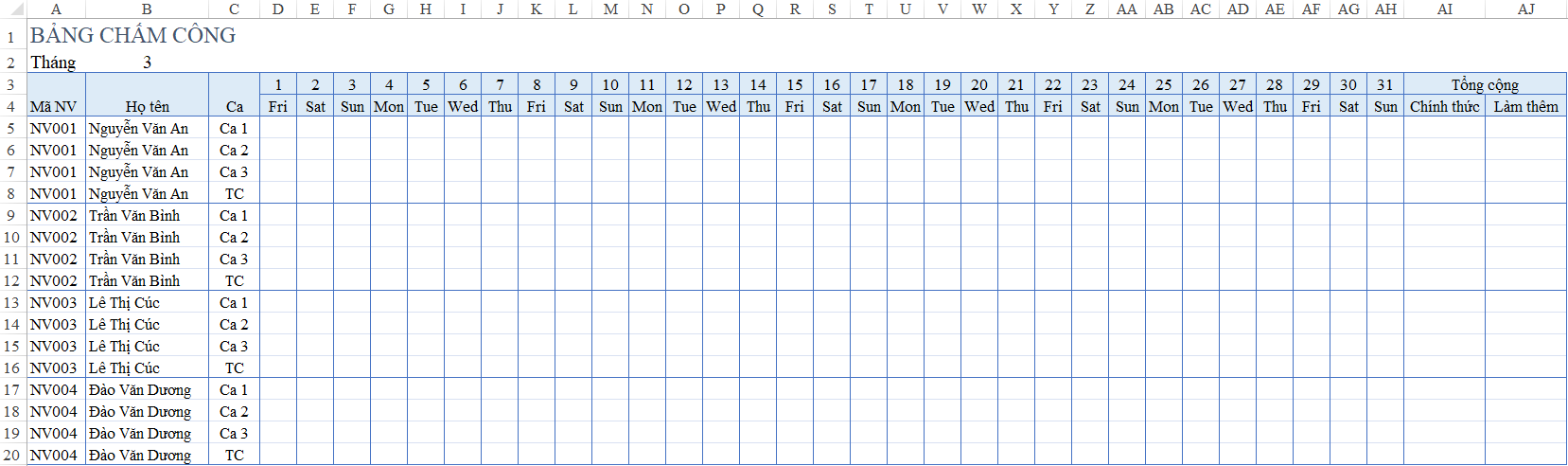 Overview of a standard shift work timesheet layout in Excel
The 4-Row Structure per Employee
To capture granularity without cluttering the view, assigning four dedicated rows to each employee is a best practice in manual Excel tracking:
- Row 1-3 (Shift Tracking): These rows correspond to Shift 1, Shift 2, and Shift 3. You will mark attendance in the specific row corresponding to the shift the employee worked that day.
- Row 4 (Overtime/OT): This row is reserved exclusively for numerical data representing overtime hours.
 Animation showing the four-row structure for a single employee
The columns should extend from Day 1 to Day 31 to cover the longest possible month. This structure ensures that visual inspection allows for an immediate understanding of an employee’s schedule distribution.
Step 2: Automating Dates and Time Intelligence
Manually typing dates and days of the week is prone to errors and makes the template difficult to reuse for subsequent months. Instead, we use Excel functions to automate this.
The DATE Formula
To determine the specific date for the column headers (Row 4 in our example), use the DATE function. This function constructs a valid Excel date based on the Year, Month, and Day index.
Syntax: =DATE(Year, Month, Day)
By referencing a central cell for the Month (e.g., cell B2) and the Day column number (e.g., D3), the spreadsheet automatically updates the entire calendar when you change the month value.
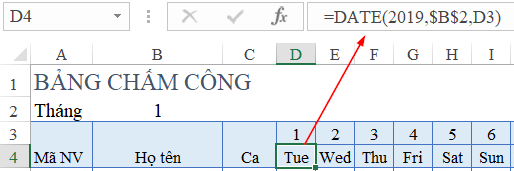 Excel screenshot demonstrating the DATE formula application
Custom Formatting for Days of the Week
Once the dates are generated, it is essential to display the corresponding day of the week (Mon, Tue, Wed) to help managers visualize weekends.
Instead of a complex formula, use Excel’s Custom Format feature:
- Select the row containing your date formulas.
- Navigate to Format Cells (Ctrl + 1).
- Choose Custom.
- In the “Type” field, enter
ddd.
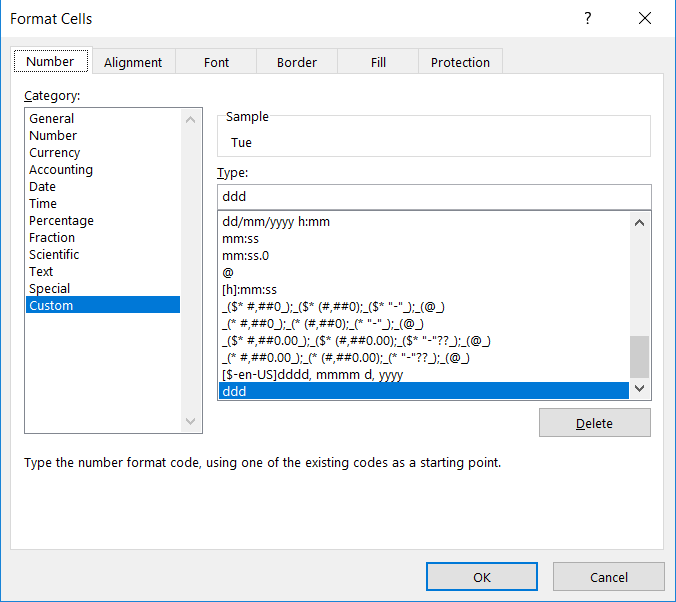 Format Cells dialog box showing the ddd custom setting
This forces Excel to display “Mon” or “Fri” while keeping the underlying value as a calculable date. This is critical for conditional formatting (e.g., automatically highlighting Sundays in red) later on.
Step 3: Data Entry Best Practices
Consistency in data entry is vital for the summary formulas to work correctly. A hybrid approach using symbols for attendance and numbers for overtime is recommended.
Standard Convention:
- X: Present (Full shift).
- P: Paid Leave (Permission).
- K: Unpaid Leave (No Permission).
- Numeric Value (e.g., 2, 1.5): Overtime hours.
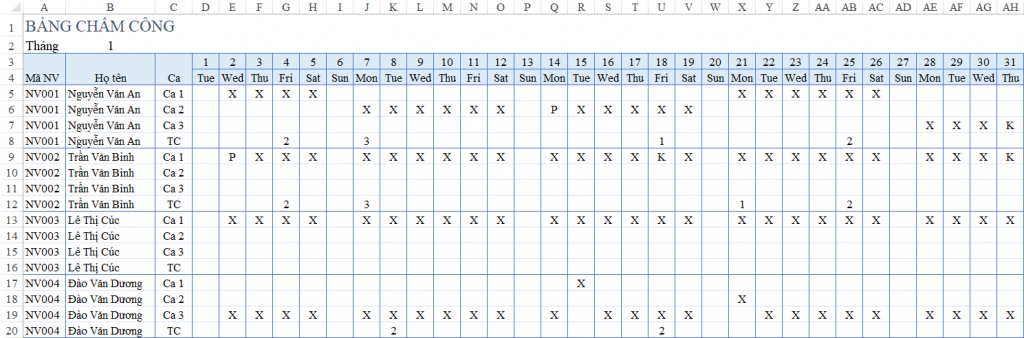 Example of a populated timesheet with attendance symbols and overtime numbers
Operational Rule: Each day should only have one attendance marker (Shift 1, 2, or 3). However, overtime is recorded on the same day column but in the dedicated OT row.
Example: If Employee NV001 works Shift 1 on January 4th and does 2 hours of OT, you place an “X” in the Shift 1 row and a “2” in the OT row under the column for the 4th.
Step 4: Calculating Monthly Totals
The final step is transforming the raw grid data into payroll-ready summaries using statistical functions. We need to calculate the total shifts worked and total overtime hours separately.
Counting Attendance with COUNTIF
The COUNTIF function is ideal for tallying text-based markers (X, P, K).
Formulas:
- Total Shifts Worked:
=COUNTIF(Range, "X") - Total Paid Leave:
=COUNTIF(Range, "P") - Total Unpaid Leave:
=COUNTIF(Range, "K")
Where “Range” refers to the cells corresponding to the employee’s shift rows for the entire month.
Summing Overtime with SUM
Since overtime is recorded as raw numbers, the standard SUM function is sufficient.
Formula:
- Total OT Hours:
=SUM(Range_OT)
Where “Range_OT” refers specifically to the 4th row (OT row) of that employee.
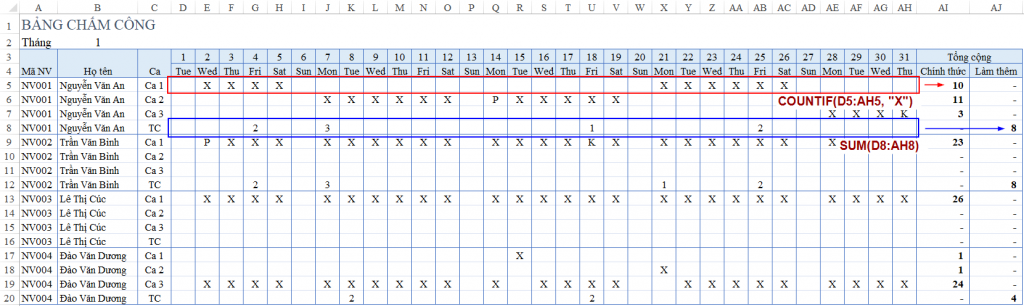 Spreadsheet showing the final calculation columns using SUM and COUNTIF
By separating the qualitative data (attendance status) from quantitative data (hours), you avoid complex array formulas and keep the spreadsheet lightweight and auditable.
Conclusion
Implementing a structured Excel timesheet for shift and overtime tracking is a significant upgrade for SMEs moving away from paper records. By utilizing the 4-row layout combined with DATE, COUNTIF, and SUM functions, businesses can ensure accuracy in payroll processing and gain better visibility into workforce availability.
While this guide covers the core mechanics, users are encouraged to further enhance this template with Data Validation (to prevent invalid entries) and Conditional Formatting (to visualize absences). Mastering these Excel fundamentals provides a solid foundation for more advanced HR analytics.
References
- Microsoft Support. (n.d.). Use COUNTIF to count cells based on criteria.
- ExcelJet. (n.d.). Excel Formula: Get day name from date.
- TechCommunity Microsoft. (2023). Best practices for time tracking in Excel.












Discussion about this post