


In the realm of financial reporting and data analysis, clarity is paramount. When dealing with substantial figures—revenue in the billions or budget variances in the millions—standard numeric formatting can make spreadsheets look cluttered and difficult to interpret. As a result, Excel users often struggle to present large datasets concisely without altering the underlying values.
Effective data visualization is not just about charts; it is about how the raw numbers are presented. This guide delves into the Custom Format feature in Excel, a powerful tool that allows you to abbreviate large currency figures into readable units like thousands (K), millions (M), and billions (B). Mastering this technique will significantly enhance the professionalism of your financial dashboards and reports.
Understanding the Logic of Custom Formatting
Before diving into the step-by-step process, it is essential to understand why we use Custom Formatting rather than simply dividing the numbers by 1,000 or 1,000,000 in a formula. When you use a formula (e.g., =A1/1000), you change the actual value of the cell. This can lead to rounding errors in subsequent calculations.
Custom Formatting, however, acts as a “mask.” It changes how the number looks to the user, but Excel continues to store the precise, original value for all background calculations. This ensures data integrity while maximizing readability.
Step-by-Step Guide to Formatting Large Numbers
To implement these formats, follow the workflow below. We will address both the standard US formatting (using commas as separators) and the European variation often found in specific system locales.
Step 1: Select Data and Access Format Cells
Begin by highlighting the range of cells containing the currency data you wish to format. Proper selection ensures consistency across your entire report.
Once selected, right-click on the highlighted area and choose Format Cells from the context menu. Alternatively, you can use the keyboard shortcut Ctrl + 1 to open the dialog box instantly.
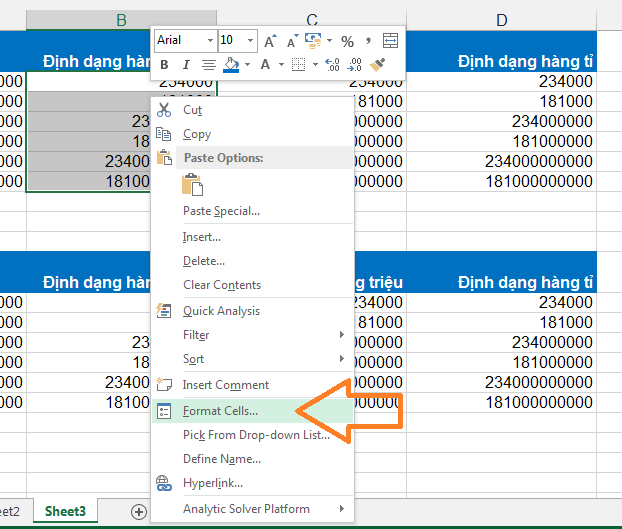 Context menu in Excel showing the Format Cells option highlighted
Step 2: Applying the Custom Syntax
In the Format Cells window, navigate to the Number tab. In the “Category” list on the left, select Custom. This unlocks the “Type” input box where you can manually define your formatting codes.
Here is where the technical magic happens. Excel uses specific syntax to drop zeros:
- One comma (
,): Removes the last 3 digits (divides visual display by 1,000). - Two commas (
,,): Removes the last 6 digits (divides visual display by 1,000,000). - Three commas (
,,,): Removes the last 9 digits (divides visual display by 1,000,000,000).
Note: If your computer’s region settings use a dot (.) as the thousands separator (common in Vietnam or Europe), you will use dots instead of commas in the codes below.
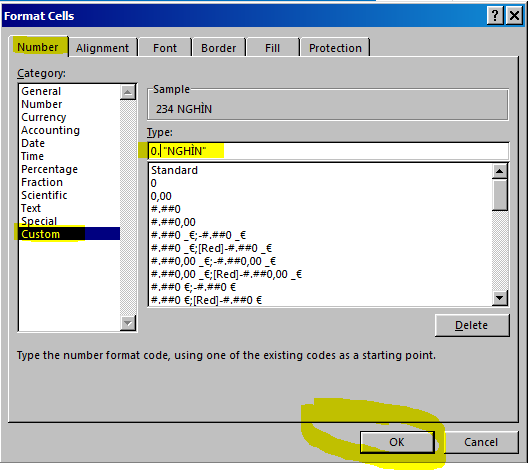 The Format Cells dialog box displaying the Custom category and Type input field
Step 3: Specific Codes for Currency Units
Depending on your reporting requirements, input one of the following codes into the “Type” box.
For Thousands (K):
To display “150,000” as “150 K”:
- Code:
#,##0, "K" - Explanation: The comma after the zero scales the number by a thousand. The text inside quotes is the suffix.
For Millions (M):
To display “15,500,000” as “15.5 M”:
- Code:
#,##0.0,, "M" - Explanation: Two commas scale the number by a million. Adding
.0ensures one decimal place is shown for precision.
For Billions (B):
To display “12,000,000,000” as “12 B”:
- Code:
#,##0,,, "B"
After entering the code, check the “Sample” preview box above the input field to verify the output looks correct before clicking OK.
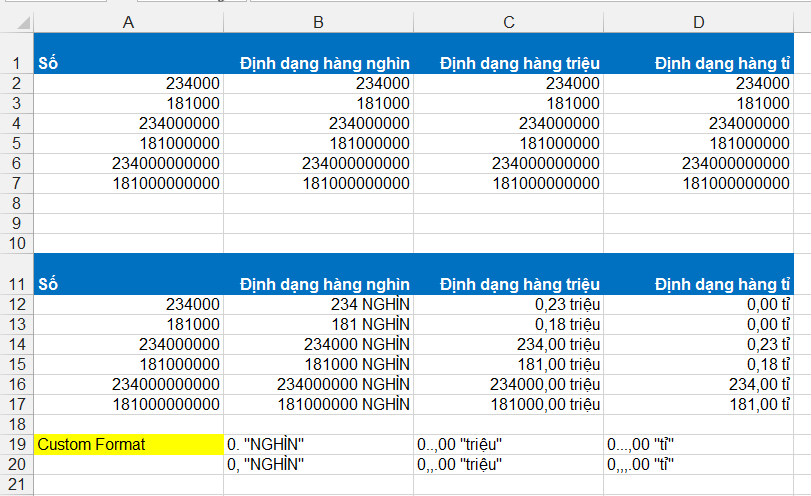 A spreadsheet comparison showing raw data versus formatted currency in K, M, and B units
Advanced Learning and Resources
Visualizing data effectively is a cornerstone of modern Excel proficiency. While formatting cells is a foundational skill, automating these processes can save hours of manual work. For those looking to automate formatting logic or build dynamic dashboards, learning VBA (Visual Basic for Applications) is the next logical step.
 Animated banner promoting a VBA 101 course for Excel automation
Furthermore, comprehensive Excel knowledge involves understanding how these formats interact with conditional formatting and pivot tables. Structured learning paths can help solidify these concepts, moving you from basic data entry to expert-level data modeling.
 Animated banner promoting a comprehensive Excel 101 course from basic to expert
Conclusion
Custom Number Formatting in Excel is an indispensable technique for anyone dealing with financial data. By converting unwieldy figures into concise units like thousands, millions, or billions, you not only improve the aesthetic appeal of your spreadsheets but also enhance the cognitive ease for your readers.
Remember to check your system’s regional settings to determine whether to use commas or dots as separators. Start applying these custom codes to your monthly reports today to deliver cleaner, more professional insights.
References
- Microsoft Support. (n.d.). Create or delete a custom number format. Retrieved from Microsoft.com
- Excel Jet. (n.d.). Custom Number Formats. Retrieved from ExcelJet.net











Discussion about this post