

Printing documents in Microsoft Word is a fundamental office skill, yet many users limit themselves to the default settings without fully utilizing the software’s powerful customization options. Whether you need to print an entire thesis, a single active page for proofreading, or a non-sequential selection of specific pages, mastering these controls can save significant time, paper, and ink. This comprehensive guide will walk you through the precise steps to handle various printing scenarios in Microsoft Word, ensuring you achieve professional results every time. Before starting, please ensure your computer is properly connected to your printer and the drivers are up to date.
How to Print an Entire Document
Printing the full content of a document is the most common requirement. Microsoft Word provides a streamlined interface for this, which can be accessed via the Ribbon menu or a keyboard shortcut.
Accessing the Print Interface
There are two primary ways to open the print settings:
- Via the Ribbon: Click on the File tab in the top-left corner and select Print from the sidebar.
- Via Shortcut: Press the Ctrl + P key combination on your keyboard. This is the fastest method and works across almost all Windows applications.
Once the Print dialog box appears, the default setting is usually Print All Pages. However, to ensure the output matches your requirements, you should review the configuration options under the Settings section:
- Print One Sided / Manually Print on Both Sides: Choose whether to print on a single side or use duplex printing to save paper.
- Collated: Essential for multi-copy jobs. “Collated” prints the full document sets in order (1, 2, 3), while “Uncollated” prints all copies of page 1, then all copies of page 2.
- Orientation: Switch between Portrait (vertical) and Landscape (horizontal).
- Paper Size: Select the correct format, such as Letter or A4, to match the physical paper in your printer tray.
- Margins: Adjust white space around the text (Normal, Narrow, or Wide).
- Pages Per Sheet: Useful for drafts, allowing you to shrink multiple document pages onto a single sheet of paper.
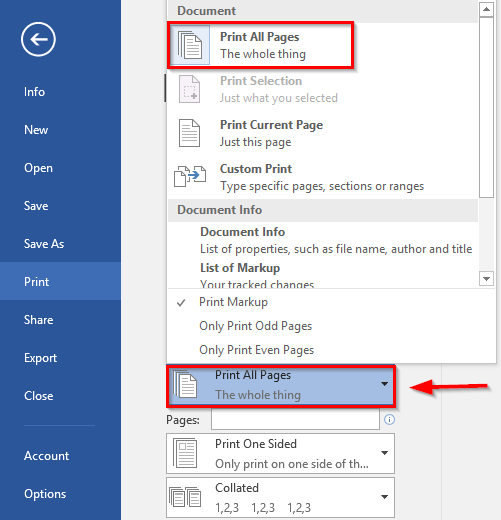 Microsoft Word Print Settings menu with Print All Pages selected
After verifying these parameters, simply click the large Print button at the top of the pane to execute the job.
How to Print a Single Page
There are scenarios where you only need to review the specific page you are currently editing. Instead of wasting paper printing the whole file or manually searching for the page number, Word offers a “Current Page” feature.
To utilize this feature effectively:
- Place your mouse cursor (insertion point) anywhere on the text of the specific page you wish to print.
- Open the Print menu via File > Print or Ctrl + P.
- Under the Settings dropdown menu (which usually says “Print All Pages”), select Print Current Page.
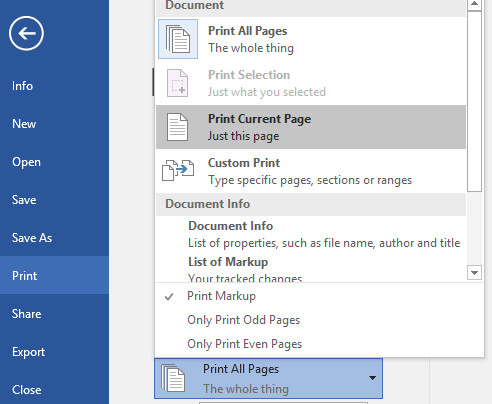 Selecting Print Current Page option in Word settings dropdown
Once selected, Word will ignore the rest of the document and send only the page where your cursor is located to the printer. You can still adjust orientation and margins as described in the previous section before hitting Print.
How to Print Specific Pages or Custom Ranges
For larger documents, such as contracts or academic papers, you may need to print a specific section or a random assortment of pages. Microsoft Word’s Custom Print feature allows for precise control using simple syntax.
Follow these steps to configure a custom print job:
- Navigate to the Print menu (Ctrl + P).
- In the Settings dropdown, select Custom Print.
- Locate the Pages input box immediately below the dropdown.
You can enter page numbers using two specific separators:
- Hyphen (-): Use this for a range of continuous pages. For example, entering
1-5will print pages 1, 2, 3, 4, and 5. - Comma (,): Use this for non-continuous individual pages. For example, entering
1,3,5will print only those three specific pages.
You can also combine these methods. For instance, entering 1-3, 8, 10-12 will print the first three pages, page 8, and then pages 10 through 12.
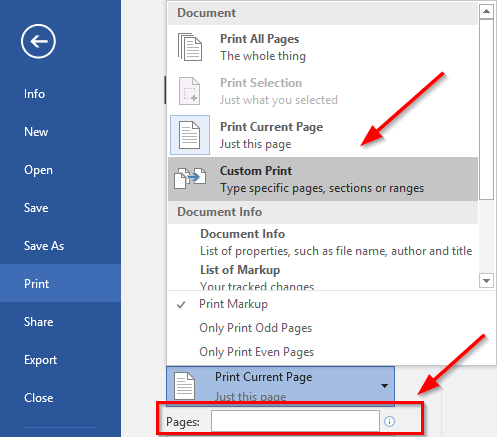 Entering custom page numbers in the Pages field in Word
Double-check your entry in the Pages box to ensure accuracy, adjust any other necessary layout settings, and click Print to finish.
Conclusion
Printing in Microsoft Word is a versatile process that goes beyond simply hitting a button. By understanding how to toggle between printing all pages, the current page, or a custom range, you can significantly improve your office efficiency and reduce paper waste. We hope this guide has clarified the various printing techniques available in Word.
For more productivity tips and deep dives into Microsoft Office tools, continue exploring “Thủ Thuật”. Whether you are looking to master page numbering, header formatting, or advanced data merging, expanding your technical knowledge will serve you well in any professional environment.
References
- Microsoft Support: “Print a document in Word”
- GCFGlobal: “Word: Printing Documents”
- Digital Trends: “How to print selected pages in Microsoft Word”










Discussion about this post