


In the professional world, data is your most valuable asset. For users of Microsoft Outlook, this data—comprising years of emails, critical contacts, meticulous calendar appointments, and task lists—is often stored locally on your machine. While Outlook is a robust platform, hardware failures, system crashes, or corrupt updates can happen at any time.
If you are using Outlook 2007, 2010, 2013, or 2016, understanding how to manually backup your data is a fundamental skill. While Outlook automatically stores emails in a Personal Storage Table (.pst) file, a comprehensive backup strategy requires more than just relying on the default settings. Certain elements, such as custom signatures, email templates, and account-specific configurations, are stored separately from your main data file.
This article serves as a deep dive into the technical procedures for securing your Outlook ecosystem. We will cover both the automated export wizard method and the manual file handling method to ensure you can restore your digital life seamlessly when moving to a new computer or recovering from a disaster.
Method 1: Exporting Data to a .PST File (Recommended)
The most reliable way to backup Outlook data is by using the built-in “Import and Export” wizard. This process creates a portable .pst file containing your emails, contacts, calendar entries, and notes. This file can be easily imported into any instance of Outlook on any computer.
Step-by-Step Guide for Outlook 2013 and 2016
The interface for Outlook 2013 and 2016 is very similar. To begin the backup process, launch the application and click on the File tab in the top ribbon. Navigate to Open & Export and select the Import/Export button.
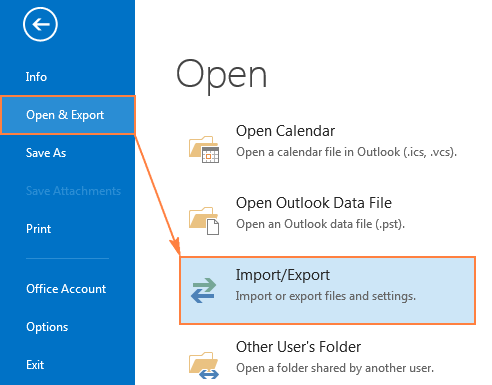 Screenshot of the File menu in Outlook 2013 showing the Open and Export options
This action opens the Import and Export Wizard. Here, you will see a list of actions. Select Export to a file and click Next. This tells Outlook that you want to extract data rather than bring it in.
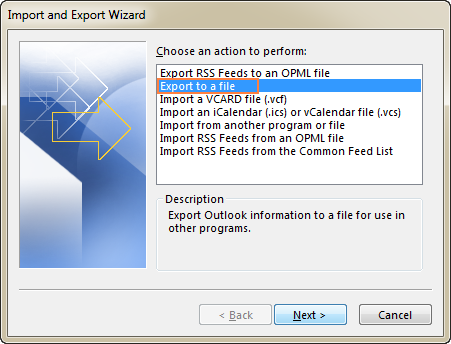 Import and Export Wizard window selecting Export to a file
On the next screen, you must choose the file type. Select Outlook Data File (.pst) and click Next. Do not choose the Comma Separated Values (CSV) option unless you specifically need to export contacts to Excel. The .pst format is required to preserve full email metadata and folder structures.
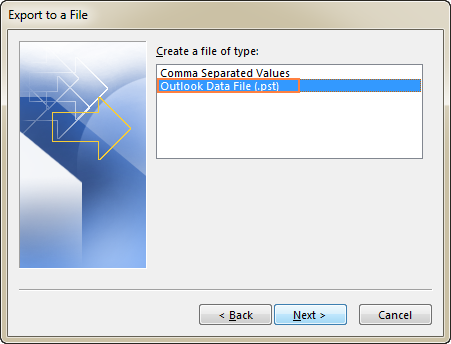 Selecting Outlook Data File .pst in the export wizard
Now, select the email account or specific folder you wish to backup. To ensure a complete backup, select the top-level folder (usually your email address) and ensure the checkbox for Include subfolders is ticked. This ensures that your Inbox, Sent Items, Drafts, Contacts, Calendar, Tasks, and Notes are all included.
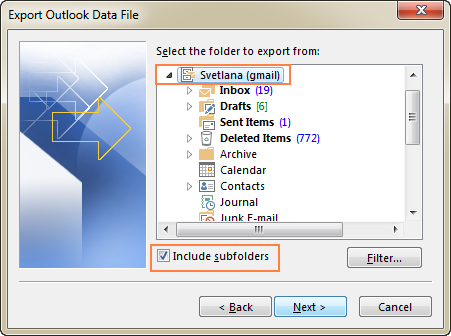 Selecting the specific email account and folders to backup
Next, you will define where to save the file. By default, Outlook saves this to C:Users[Username]DocumentsOutlook Filesbackup.pst. You can click Browse to save it to an external hard drive or a different partition for safety.
In the Options section, you have three choices regarding duplicates. The default option, Replace duplicates with items exported, is generally the safest bet as it ensures your backup reflects the most current version of your data.
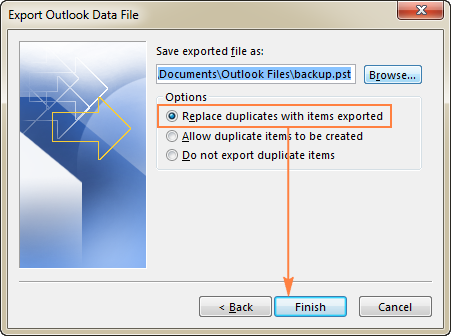 Final step of the export wizard showing duplicate handling options
Finally, Outlook will offer the option to add a password to the .pst file. If you are backing up sensitive corporate data to a shared drive or portable USB, it is highly recommended to set a strong password. If this is a personal backup on a secure home computer, you may leave both fields blank and click OK to skip encryption.
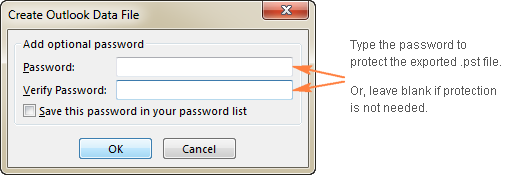 Dialog box for setting an optional password on the backup file
Note: The export process may take several minutes to complete depending on the size of your mailbox. Do not close Outlook until the process finishes.
Instructions for Outlook 2010 Users
For those still utilizing Outlook 2010, the path to the wizard is slightly different. You need to navigate to File > Options. In the Outlook Options window, click on the Advanced tab.
Scroll down until you find the Export section and click the Export button. From this point forward, the steps are identical to steps 2 through 6 outlined above for the newer versions.
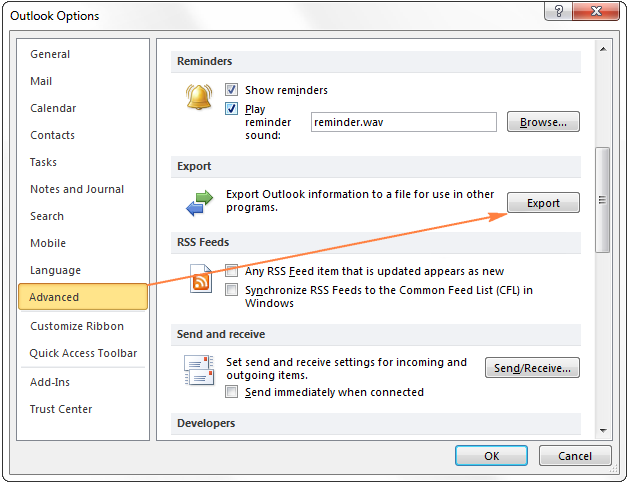 Outlook 2010 Options window highlighting the Export button in the Advanced tab
Instructions for Outlook 2007 Users
In Outlook 2007, the interface predates the “Ribbon” style. To access the backup feature, simply click on the File menu in the top toolbar and select Import and Export. The subsequent wizard steps for selecting folders and saving the .pst file remain consistent with modern versions.
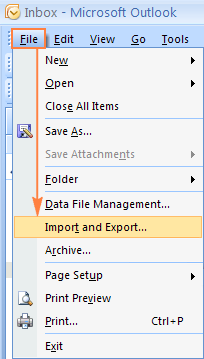 The File menu in Outlook 2007 showing the Import and Export option
Method 2: Manual File Copy (For Advanced Users)
If you prefer to handle files directly via Windows Explorer, or if Outlook refuses to open, you can manually copy the .pst files. This method is faster for large backups but requires you to know exactly where the files are located.
Crucial Warning: You must completely close Microsoft Outlook before attempting to copy the .pst file. If the application is open, the file will be locked, and the copy process will fail or result in data corruption.
Locating Your Outlook Data Files
The storage location of your .pst files depends on your version of Windows and Outlook. Here are the standard paths:
- Outlook 2013 & 2016 (Windows 8, 10, 11):
C:Users[Username]DocumentsOutlook Files - Outlook 2010:
C:Users[Username]DocumentsOutlook Files - Legacy Locations (Outlook 2007 or Upgrades):
C:Users[Username]AppDataLocalMicrosoftOutlook
Note: The AppData folder is hidden by default. To view it, open File Explorer, go to the View tab, and check Hidden items.
Verifying the File Location via Outlook
To be absolutely certain you are backing up the correct file (especially if you have multiple accounts), you can check the path inside Outlook before closing it:
- Go to File > Account Settings > Account Settings.
- Click on the Data Files tab.
- Select your account and click Open File Location….
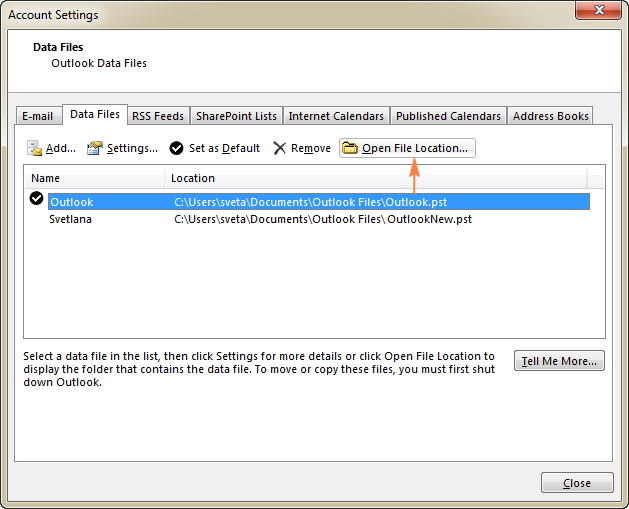 Account Settings window in Outlook showing the Data Files tab and Open File Location button
This will open the exact folder containing your live data. You can then close Outlook and copy the .pst file to your backup drive.
Beyond the PST: Backing Up Settings and Signatures
A common mistake users make is assuming the .pst file contains everything. It does not. Your email signatures and custom stationery templates are stored in separate directories within Windows. If you move to a new PC without these, you will have to recreate them from scratch.
To backup these items, navigate to the following folders and copy their contents:
- Signatures:
C:Users[Username]AppDataRoamingMicrosoftSignatures - Stationery/Templates:
C:Users[Username]AppDataRoamingMicrosoftTemplates - Custom Dictionary:
C:Users[Username]AppDataRoamingMicrosoftUProof
Special Considerations: Office 365 and Exchange
If you are using an Office 365 or Microsoft Exchange account, your data is primarily stored on the mail server, not just your local machine. This means if your computer breaks, your email is safe in the cloud. Outlook caches this data locally in an .ost file (Offline Storage Table), which cannot be simply moved to a new computer like a .pst file.
However, many professionals still prefer a local “hard copy” backup of their cloud emails for archival purposes. To do this, you can use Method 1 (Export to .pst) described above. This allows you to create a static snapshot of your Exchange mailbox that you can access offline indefinitely.
For Exchange users, you can also utilize the AutoArchive feature to automatically move older emails from the server to a local archive file to free up space:
- Go to File > Options > Advanced > AutoArchive Settings.
Conclusion
Regularly backing up your Outlook data is not just a technical recommendation; it is a necessity for maintaining professional continuity. Whether you choose the user-friendly Export Wizard to create a structured backup or the Manual Copy method for speed, the key is consistency.
We recommend performing a full backup at least once a month, or weekly if you handle high volumes of critical correspondence. Additionally, remember to backup your AppData folders to preserve your signatures and personal configurations. By following these steps, you ensure that no matter what happens to your hardware, your communication history remains secure and accessible.
References
- Microsoft Support: Back up your email, contacts, and calendar.
- Lifewire: How to manage Outlook PST files.
- TechRepublic: Best practices for Outlook data management.












Discussion about this post