
For most Excel users, merging cells to create headers or organize layouts is a familiar task. However, data analysts and office professionals often face the opposite challenge: splitting a single cell containing multiple data points into separate cells. Whether you are separating full names into first and last names or parsing addresses, knowing how to split cells effectively is a crucial skill.
This guide will demonstrate the most effective methods to split cells in Excel, ranging from the built-in “Text to Columns” feature to advanced formula techniques for dynamic data processing.
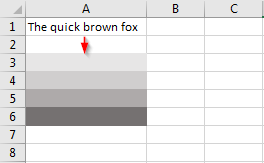
Excel spreadsheet showing a cell containing a full sentence to be split
Method 1: Splitting Cells Using Text to Columns
The Text to Columns feature is the standard, most user-friendly tool in Excel for parsing data. It is particularly useful for static data where you need to separate content based on a specific character, such as a comma, space, or hyphen.
Consider a scenario where you have a sentence or a list of items in a single cell and need to distribute each word into its own column.
Accessing the Text to Columns feature in the Data tab
Step-by-Step Execution
To begin the process, highlight the cell or range of cells containing the data you wish to split. Navigate to the Data tab on the Ribbon and click on Text to Columns. This will open the conversion wizard.
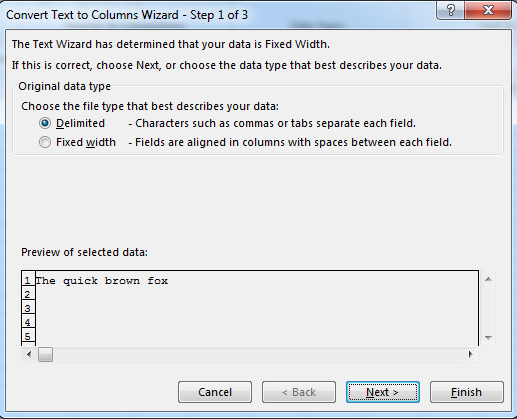
In the first step of the wizard, you will see two options: Delimited and Fixed width. For most text-splitting tasks (like names or sentences), select Delimited. This tells Excel that your data is separated by specific characters rather than fixed spacing.
Selecting the Delimited option in the Convert Text to Columns Wizard
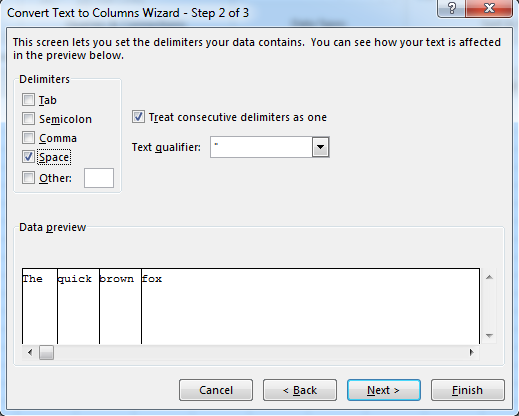
Click Next to proceed to the delimiter selection screen. Here, you define what separates your data. In our example, since we are splitting words in a sentence, check the box for Space. You will see a live preview of how the data will be divided in the “Data preview” window.
Selecting Space as the delimiter in the wizard settings
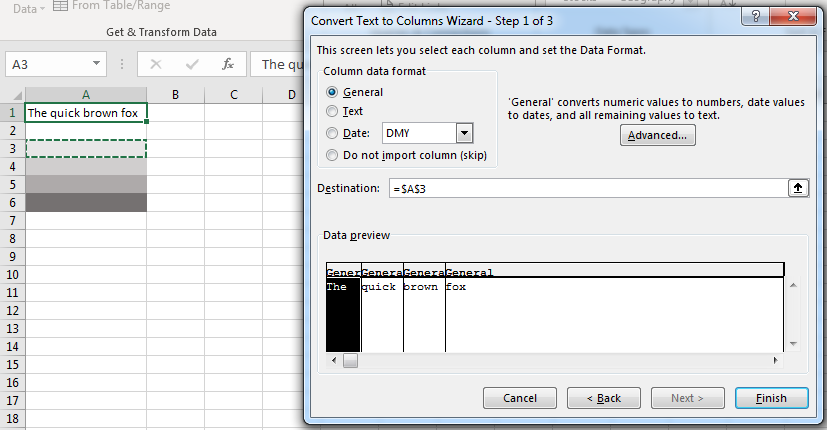
Once you are satisfied with the preview, click Finish. Excel will immediately distribute the content across adjacent columns. Be sure there are empty columns next to your source data, as this process will overwrite any existing content in those cells.
Animation showing the text to columns process in action
Handling the Result
After clicking finish, your single cell of text will be spread horizontally across the row. This allows for easier sorting and filtering of individual data components.
Data successfully split into separate columns
In some cases, you may prefer the data to be listed vertically (in rows) rather than horizontally (in columns). You do not need to move them manually. Simply copy the newly split cells, right-click the destination cell, and choose Paste Special. Select the Transpose option to rotate the data orientation.
Using Paste Special to Transpose data from rows to columns
Method 2: Splitting Cells Using Advanced Formulas
While “Text to Columns” is excellent for one-time tasks, it is static. If the original data changes, the split cells do not update automatically. For dynamic workflows, using a combination of Excel functions is the professional choice.
This method allows you to extract specific words or split text strings into a vertical list using a single formula array.
Entering the text parsing formula into a specific cell
The Formula Breakdown
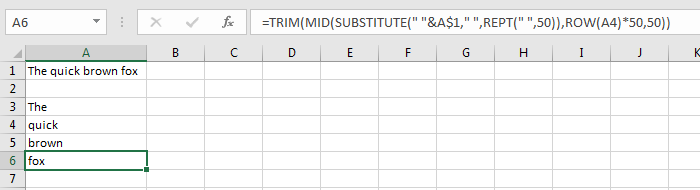
To split a sentence from cell A1 into a vertical list starting at cell A3, you can use a combination of TRIM, MID, SUBSTITUTE, and REPT. Enter the following formula into cell A3:
=TRIM(MID(SUBSTITUTE(" "&A$1," ",REPT(" ",50)),ROW(A1)*50,50))How this works:
- SUBSTITUTE & REPT: Replaces every single space in the original text with 50 spaces. This pushes the words far apart.
- MID & ROW: Extracts a specific chunk of text based on the row number you are in. As you drag the formula down, it grabs the next “chunk” of 50 characters.
- TRIM: Removes all the excess spaces created in step 1, leaving only the clean word.
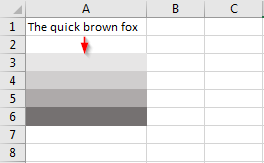
After entering the formula, use the AutoFill handle to drag the formula down until all words have been extracted.
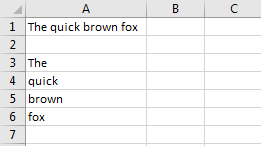
List of words split vertically using the Excel formula
Technical Note: The value “50” in the formula is an arbitrary large number sufficient for most words. If your data contains very long strings (e.g., URLs or DNA sequences), you may need to increase this number to 100 or more. Additionally, if your data is separated by commas instead of spaces, simply change the " " in the SUBSTITUTE function to ",".
Conclusion
Mastering data manipulation is essential for efficiency in Excel. We have explored two primary methods for splitting cells: the Text to Columns wizard for quick, static parsing, and complex formulas for dynamic, automated solutions.
Choosing the right method depends on your specific needs. If you are preparing a one-off report, the Ribbon tool is faster. However, for dashboards or templates where data is constantly updated, the formula approach ensures your data structure remains intact without manual intervention. Apply these techniques to your daily workflow to significantly reduce data processing time.


Discussion about this post