


Excel is arguably the most powerful tool for data analysis and calculation used in businesses today. While data entry is simple, the true magic of Microsoft Excel lies in its ability to compute, analyze, and automate tasks through formulas. Whether you are a student, an office clerk, or a data analyst, mastering these equations is the first step toward professional efficiency.
This comprehensive guide will walk you through the architecture of Excel formulas, from the absolute basics to complex nested functions, ensuring you have the technical foundation to handle any spreadsheet challenge.
Understanding the Core of Excel Formulas
In the ecosystem of Microsoft Excel, a formula is an expression that operates on values in a range of cells or cells. These formulas return a result, which can be a number, text, or even a date. The fundamental syntax has remained consistent from Excel 2007 through Excel 2016 and into the modern Microsoft 365 versions.
The Golden Rule: The Equal Sign
Every single formula in Excel must begin with an equal sign (=). This signal tells Excel that the subsequent characters constitute a formula, not just plain text.
For example, if you want to calculate the sum of values in cells B1 through B5, you have two primary methods:
- Direct Calculation:
=B1+B2+B3+B4+B5 - Using a Function:
=SUM(B1:B5)
Once typed, pressing Enter executes the command and displays the result.
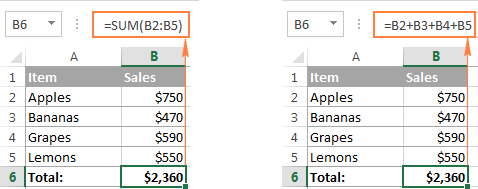 Basic formula structure in Microsoft Excel showing the equals sign
The Anatomy of an Excel Formula
To debug or create complex calculations, you must understand the building blocks that make up a formula. A robust formula is often a combination of several elements working in unison.
A typical formula may contain the following components:
- Constants: Fixed values (numbers or text) that do not change, such as
=2*3. - Cell References: Pointers to specific cells containing data, like
=SUM(A1, A2, B5). Using references ensures your result updates automatically if the source data changes. - Named Ranges: defined names for a cell or range, making formulas easier to read (e.g.,
=SUM(Revenue)instead of=SUM(C2:C100)). - Functions: Pre-defined formulas built into Excel (like
SUM,AVERAGE,VLOOKUP) that simplify complex operations. - Operators: Symbols that specify the type of calculation to perform.
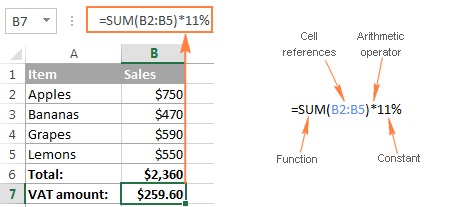 Breakdown of Excel formula elements including functions and arguments
Deep Dive into Excel Operators
Operators are the engine of your formulas. Excel categorizes them into four distinct types, each serving a specific logical or mathematical purpose.
1. Arithmetic Operators
These are used for basic mathematical operations. They are the most frequently used symbols in financial modeling and basic data work.
| Operator | Description | Example | Result/Meaning |
|---|---|---|---|
| + | Addition | =A2+B2 | Adds values in A2 and B2 |
| – | Subtraction | =A2-B2 | Subtracts B2 from A2 |
| * | Multiplication | =A2*B2 | Multiplies A2 by B2 |
| / | Division | =A2/B2 | Divides A2 by B2 |
| % | Percentage | =A2*10% | Calculates 10% of A2 |
| ^ | Exponentiation | =A2^3 | Raises A2 to the power of 3 |
For instance, creating a VAT calculation is straightforward: Multiply the price (A2) by the tax rate (B2).
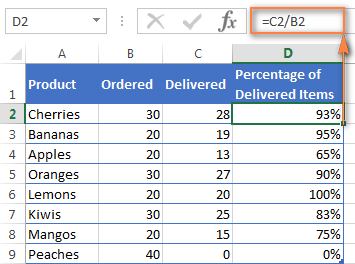 Example of arithmetic operators used for percentage calculation
2. Comparison (Logical) Operators
These operators compare two values and always return a Boolean result: either TRUE or FALSE. They are essential for logical functions like IF, COUNTIF, or conditional formatting.
| Operator | Description | Example |
|---|---|---|
| = | Equal to | =A2=B2 |
| <> | Not equal to | =A2<>B2 |
| > | Greater than | =A2>B2 |
| < | Less than | =A2<B2 |
| >= | Greater than or equal to | =A2>=B2 |
| <= | Less than or equal to | =A2<=B2 |
Visual feedback is often used alongside these operators to validate data entries instantly.
 Animation demonstrating logical checks in Excel
3. Text Concatenation Operator
The ampersand (&) is used to join (concatenate) two or more text strings into one. This is particularly useful for cleaning data, such as combining a First Name and Last Name column into a Full Name column.
- Example:
=A1 & " " & B1- This formula takes the value in A1, adds a space (” “), and appends the value in B1.
While the CONCATENATE (or the newer CONCAT) function exists, using & is often faster for simple tasks.
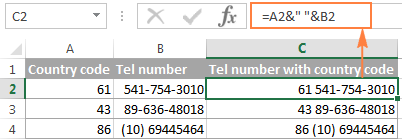 Joining text strings using the ampersand operator
4. Reference Operators
These symbols define ranges of cells for functions to process.
- Colon (
:): Range operator. Defines a range between two references.A1:A100includes all cells from A1 to A100.A:Arefers to the entire A column.
- Comma (
,): Union operator. Combines multiple references into one.=SUM(A1:A10, C1:C10)sums two separate ranges.- Note: In some European regions, a semicolon (
;) is used instead of a comma.
- Space ( ): Intersection operator. Returns the reference to the cells common to two ranges.
=B3:D3 C2:C4refers to cell C3, where the row and column intersect.
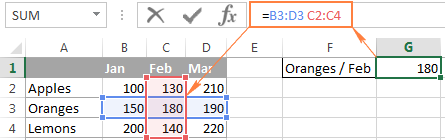 Intersection operator example using space between ranges
The Hierarchy of Calculation (Order of Operations)
Excel follows standard mathematical protocols (PEMDAS) when calculating results. Understanding this order is critical to preventing calculation errors in complex financial models.
The priority order is:
- Parentheses
(): Operations inside brackets are calculated first. - Exponents
^: Powers and roots. - *Multiplication `
and Division/`**: Calculated from left to right. - Addition
+and Subtraction-: Calculated from left to right.
If you write =10+5*2, Excel calculates 5*2 first (10), then adds 10, resulting in 20. If you meant to add first, you must write =(10+5)*2, which results in 30.
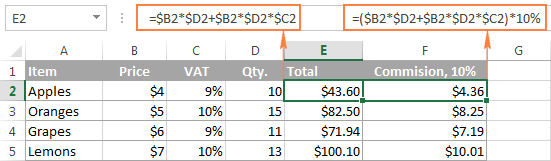 Complex formula demonstrating order of operations
Advanced Techniques: Nesting and Arrays
As you advance, you will need to perform multiple actions within a single cell.
Nested Functions
Nesting involves using a function as an argument within another function. Excel allows up to 64 levels of nesting, though highly nested formulas can become difficult to read.
- Example: Rounding a sum.
=ROUND(SUM(B2:B6), 0)
Here, Excel first calculates theSUMof the range, and then passes that result to theROUNDfunction to remove decimal places.
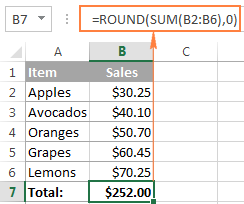 Example of nesting SUM inside the ROUND function
The most common use case for nesting is with the IF function to test multiple conditions.
- Example:
=IF(A1>90, "A", IF(A1>80, "B", "C"))
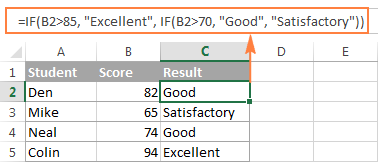 Nested IF statements for multiple conditions
Array Formulas
Array formulas are powerful tools that perform calculations on multiple items in a range simultaneously.
- Traditional Method: In older Excel versions, you must press Ctrl + Shift + Enter to activate an array formula. Excel adds curly braces
{}around the formula. - Use Case: Counting how many times Column B is greater than Column A, but only if Column B is positive:
=SUM((B2:B10>=A2:A10)*(B2:B10>0))
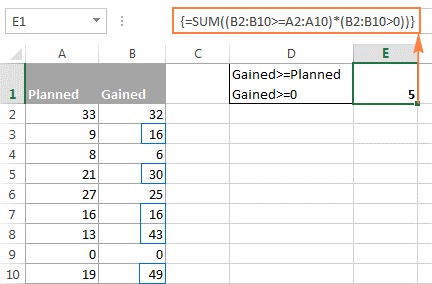 Array formula calculation example
Mastering Cell References: Absolute vs. Relative
One of the most confusing concepts for beginners is how cell references behave when copied to other cells.
- Relative Reference (e.g.,
A1): The default behavior. If you copy the formula down one row, A1 becomes A2. - Absolute Reference (e.g.,
$A$1): The reference is “locked”. If you copy the formula anywhere, it always points to A1. This is crucial for constants like tax rates or unit conversions. - Mixed Reference (e.g.,
$A1orA$1): Only the column or the row is locked.
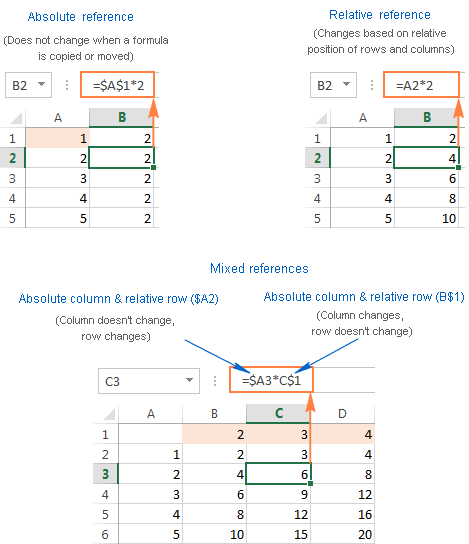 Comparison of absolute and relative cell references
Essential Shortcuts and Pro Tips
To work at the speed of thought, incorporate these shortcuts into your workflow:
- F4: Cycles through reference types (A1 -> $A$1 -> A$1 -> $A1).
- Ctrl + ` (Grave Accent): Toggles “Show Formulas” mode, displaying the code instead of the result.
- F2: Enters “Edit Mode” for the active cell.
- F9: Calculates the selected part of a formula (great for debugging complex logic).
- Double-click Fill Handle: Automatically copies the formula down the entire column based on adjacent data.
- Paste Values: (Ctrl+C, then Alt+E+S+V) converts formulas into static data.
Conclusion
Mastering Excel formulas is a journey that transforms you from a data entry clerk into a data analyst. By understanding the anatomy of a formula, the hierarchy of operators, and the power of references, you can build spreadsheets that are not only accurate but also dynamic and easy to maintain.
Start by practicing the basic arithmetic and comparison operators. Once comfortable, challenge yourself with nested IF statements and array formulas. The more you use them, the more intuitive the logic becomes.
References
- Microsoft Support: Overview of formulas in Excel
- TechCrunch: Enterprise Software Trends
- ExcelJet: Excel Formula Syntax and Usage










Discussion about this post