


Data management in Microsoft Excel often requires more than just simple sorting or standard filtering. When you need to extract specific datasets based on complex criteria and move them to a separate report sheet for analysis, the standard “Filter” button falls short. This is where the Advanced Filter feature shines, offering a robust solution for isolating and copying data without complex formulas or VBA macros.
Understanding how to leverage the Advanced Filter to copy data between sheets is a critical skill for data analysts and office professionals. It allows you to keep your raw data intact while generating clean, specific reports in seconds. In this comprehensive guide, we will walk you through the nuances of this tool, ensuring you can filter data accurately and efficiently.
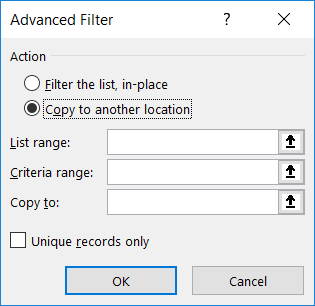 Close-up view of the Advanced Filter dialog box options in Excel
Understanding Advanced Filter Capabilities
What Sets It Apart?
The Advanced Filter is a powerful utility located within the Excel ribbon that exceeds the capabilities of the standard AutoFilter. While AutoFilter is excellent for quick, on-the-fly viewing, Advanced Filter is designed for:
- Complex Criteria: Filtering based on multiple conditions using Boolean logic (AND/OR).
- Data Extraction: Physically copying the result set to a new location rather than just hiding rows.
- Uniqueness: Instantly removing duplicates from a list.
To access this tool, navigate to the Data tab on the Ribbon. Locate the Sort & Filter group, and click on the button labeled Advanced.
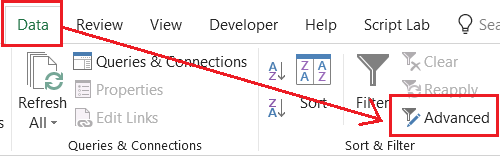 Location of the Advanced button within the Sort & Filter group on the Data tab
Key Configuration Options
When you open the tool, you are presented with a dialog box featuring several critical settings:
- Action:
- Filter the list, in-place: Hides rows that don’t match criteria (similar to standard filter).
- Copy to another location: The feature we focus on today, which extracts data to a new range.
- List range: The database or table you are filtering.
- Criteria range: A specific range of cells where you define your rules.
- Copy to: The destination cell where the filtered data will be pasted.
- Unique records only: A checkbox to eliminate duplicate entries.
The “Active Sheet” Rule
Before proceeding, it is vital to understand a specific technical quirk of Excel. To successfully copy data to a different sheet (e.g., from “Data” to “Report”), you must initiate the Advanced Filter command from the destination sheet. If you try to run the command while looking at your raw data sheet, Excel will throw an error stating that you can only copy filtered data to the active sheet.
Step-by-Step Guide: Filtering Data to a New Sheet
Let’s demonstrate this process with a practical scenario. Imagine you manage a sales database and need to extract a performance report for a specific employee named “Trang”.
1. Prepare Your Data and Criteria
First, ensure your source data is organized with clear headers. In our example, we have a sales table in a sheet named “Data”.
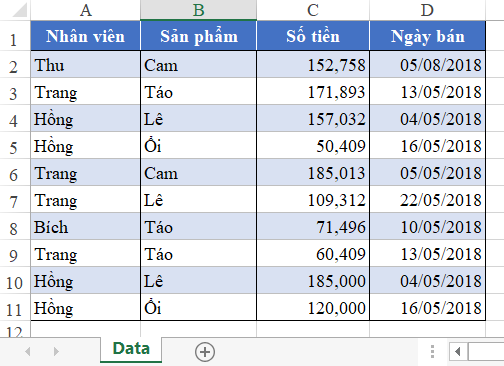 Sample sales data spreadsheet containing columns for Date, Employee, Product, and Sales
Next, create a new sheet named “Report01”. Here, you must set up your Criteria Range. Copy the exact header of the column you want to filter (e.g., “Nhân viên”) and type the value you are looking for below it (e.g., “Trang”).
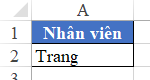 Setting up the criteria range with the header Employee and value Trang
2. Execute the Advanced Filter
Now, follow this precise sequence to avoid errors:
- Switch to the destination sheet (“Report01”). Do not stay on the “Data” sheet.
- Go to Data > Advanced.
- In the dialog box, select the radio button Copy to another location.
- List range: Click the selection arrow, switch to the “Data” sheet, and highlight your entire dataset (e.g.,
A1:D11). - Criteria range: Select the criteria headers and values you created on the “Report01” sheet (e.g.,
A1:A2). - Copy to: Select the cell on “Report01” where you want the report to start (e.g.,
A4). - Click OK.
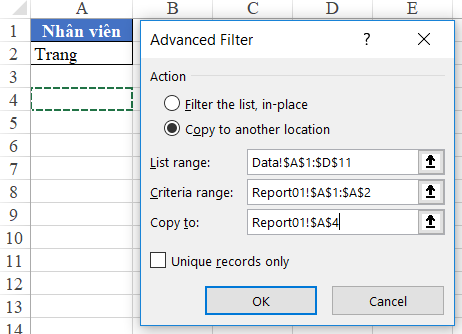 Configuration of Advanced Filter parameters including List range and Criteria range
3. Review the Output
Excel will instantly pull all records matching “Trang” from the source data and paste them into your report sheet starting at cell A4. This data is now static; it will not change if you filter the original list, allowing you to format or email this report without affecting the source.
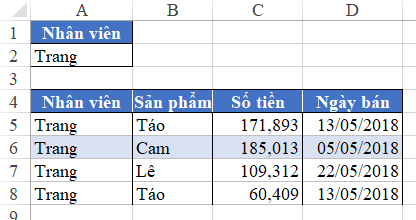 Final filtered results showing only sales records for employee Trang
Mastering Criteria Logic (AND/OR)
The true power of Advanced Filter lies in how you arrange your criteria. You can create complex logical queries simply by adjusting where you type the conditions.
The AND Condition (All Must Be True)
If you need to filter data where multiple conditions must be met simultaneously (e.g., Employee is “Trang” AND Product is “Apple”), place the criteria on the same row.
 Example of AND logic setup with criteria on the same row
In the example above, the filter will only return rows where both the Employee column contains “Trang” AND the Product column contains “Apple”.
The OR Condition (At Least One Must Be True)
If you want to find data that meets either one condition or another (e.g., Employee is “Trang” OR Employee is “Huy”), place the criteria on different rows.
 Example of OR logic setup with criteria on staggered rows
Excel interprets staggering rows as an “OR” operator. This setup returns all sales records for Trang, as well as all sales records for Huy.
Conclusion
The Advanced Filter in Excel is an indispensable tool for anyone looking to perform professional data extraction and reporting. By mastering the “Copy to another location” feature and understanding the nuances of criteria arrangement, you can save hours of manual copying and pasting.
Remember the golden rule: always initiate the Advanced Filter from the destination sheet to ensure a seamless data transfer. We encourage you to experiment with complex AND/OR criteria to unlock the full potential of your datasets.
References
- Microsoft Support: Filter by using advanced criteria.
- TechCommunity: Best practices for Excel Data Management.












Discussion about this post