


Are you struggling to manually cross-reference two different lists of data spread across separate Excel sheets? Whether you are managing customer databases, inventory lists, or financial records, ensuring data consistency is a critical task for any professional. Manually checking row by row is not only tedious but also prone to human error.
Fortunately, Microsoft Excel offers powerful logical functions that can automate this process in seconds. By mastering the COUNTIF function combined with filtering tools, you can instantly identify which data points are shared between sheets and which are unique. This guide will walk you through a step-by-step method to compare data efficiently, ensuring your reports are always accurate.
Understanding the Data Comparison Scenario
Before diving into the formulas, let’s establish a common scenario. Imagine you have a workbook with two separate sheets: Sheet A (your primary list) and Sheet B (the list you want to cross-reference). Your goal is to check every item in List A to see if it exists in List B.
This task is essential for data cleansing, such as finding missing entries or removing duplicates before merging databases.
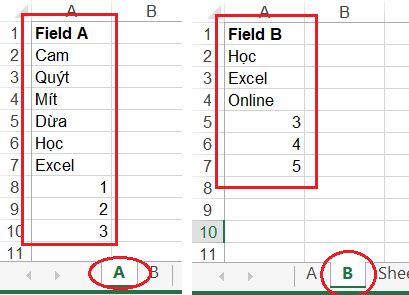 Two Excel sheets displaying separate lists of data for comparison
Step 1: Implementing the COUNTIF Function
The most efficient way to flag data presence is using the COUNTIF function. This function counts the number of cells within a range that meet a single criterion. In our context, we will ask Excel to count how many times a value from Sheet A appears in Sheet B.
The Formula Syntax
Navigate to the first empty column in Sheet A (e.g., Column B) and enter the formula. The structure involves two main arguments:
- Range: The location where you are looking for the data (Column A on Sheet B).
- Criteria: The specific item you are looking for (The cell in Sheet A).
The formula will look something like this:
=COUNTIF(SheetB!A:A, A2)
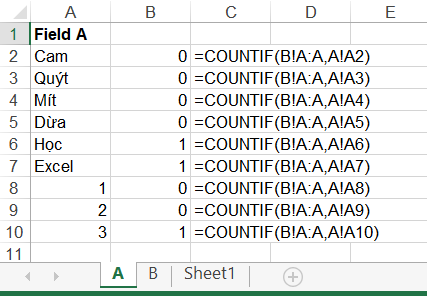 User typing the COUNTIF formula into an Excel cell
Detailed Breakdown:
SheetB!A:A: This references the entire Column A on the second sheet. Using the whole column reference ensures that even if data is added to Sheet B later, the formula remains valid.A2: This is the specific value on your current sheet (Sheet A) that you are checking.
Once you press Enter, drag the fill handle down to apply this formula to all rows in your list.
 Animation showing the COUNTIF function calculating results across rows
Step 2: Interpreting the Results
After applying the formula, you will see a column of numbers (0, 1, 2, etc.). Understanding these results is key to your analysis:
- Result = 0: This indicates that the value in Sheet A does not exist in Sheet B. These are your unique or missing items.
- Result ≥ 1: This indicates that the value in Sheet A exists in Sheet B. If the number is greater than 1, it means the item appears multiple times (duplicates) in the target list.
 Animated GIF demonstrating the logic of the COUNTIF function in action
Step 3: Isolating Data with AutoFilter
Now that you have the raw data, the next step is to organize it for action using the AutoFilter tool. This allows you to view only the specific data subset you need (e.g., only the missing items).
- Highlight your data range on Sheet A, including the new formula column.
- Navigate to the Data tab on the ribbon.
- Click on the Filter icon (symbolized by a funnel).
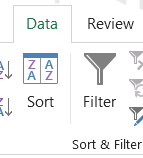 User selecting the Filter option from the Data ribbon in Excel
Filtering Strategies:
- To find common data: Click the dropdown arrow on your formula column and select all numbers except 0. This shows records present in both sheets.
- To find unique data (Sheet A only): Click the dropdown and select only 0. These are the items that are missing from Sheet B.
Step 4: Extracting and Utilizing the Data
Once you have filtered the list, you might want to move this data to a new report or highlight it.
- Select the visible cells in your original data column.
- Copy the data (
Ctrl + C). - Pro Tip: When pasting to a new location, use Paste Special > Values. This ensures you copy the actual text/numbers rather than the formulas, preventing reference errors in your new destination.
Conclusion
Comparing data between two Excel sheets doesn’t have to be a complex manual chore. By leveraging the COUNTIF function combined with AutoFilter, you transform a potentially hour-long task into a process that takes minutes. This method not only saves time but also significantly reduces the risk of oversight, ensuring your data analysis is robust and reliable.
Whether you are auditing financial discrepancies or merging contact lists, this technique is a fundamental skill for any efficient Excel user. Try applying this to your next project to streamline your workflow.
References
- Microsoft Support: COUNTIF function documentation.
- Excel Jet: How to compare two lists in Excel.
- TechCommunity Hub: Advanced filtering techniques.










Discussion about this post