


In the realm of Excel automation, the UserForm is a powerful interface tool that bridges the gap between raw spreadsheet data and a professional user experience. Among its many controls, the Combobox (or Dropdown List) stands out as an essential feature for ensuring data integrity. It prevents typing errors by forcing users to select from a predefined list of values.
This guide provides a comprehensive, step-by-step walkthrough on how to populate a UserForm Combobox with data directly from an Excel worksheet. specifically, we will demonstrate how to load a list of sales staff from a specific range (F2:F5) into a Combobox named “cbSale” using VBA code.
Understanding the Data Flow
Before diving into the code, it is crucial to understand the logic. In VBA, a UserForm does not automatically know what data exists on your spreadsheet. You must explicitly tell it where to look. By linking a specific Range on your worksheet to the Combobox control, you create a dynamic link that updates your form whenever the form initializes.
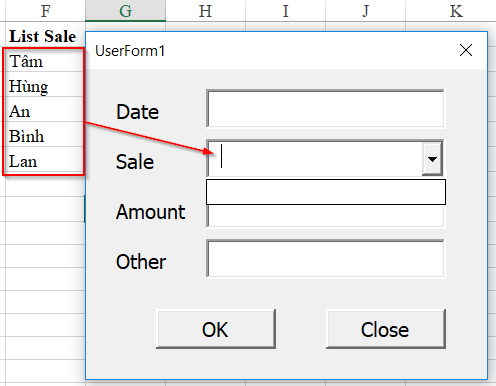 Diagram illustrating the data flow from an Excel worksheet range to a VBA UserForm Combobox
Step-by-Step Implementation Guide
To ensure the list is available the moment the user opens the tool, we will utilize the UserForm_Initialize event. This event triggers immediately when the form is loaded into memory, making it the perfect place to inject data.
The following visual guide provides a quick overview of the entire process, from accessing the Visual Basic Editor to running the form.
 Animated guide showing the process of creating a selection list in VBA
Step 1: Accessing the Visual Basic Environment
To begin, you need to enter the backend of Excel. Press Alt + F11 to open the Visual Basic for Applications (VBA) window. Locate your project in the “Project Explorer” pane on the left side. Find UserForm1 (or the name of your specific form), right-click on it, and select View Code.
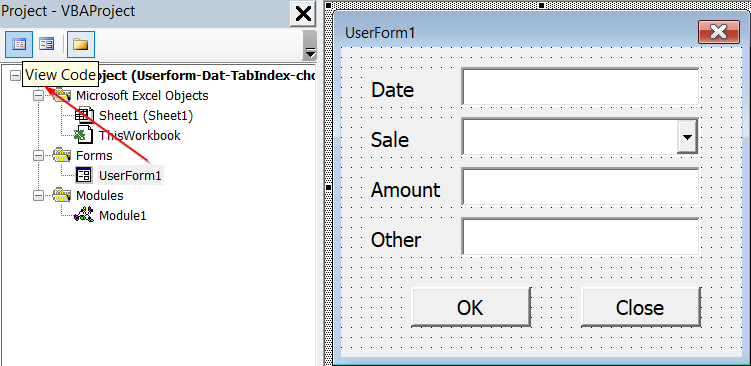 Screenshot of the VBA Project Explorer menu selecting View Code
Step 2: Selecting the Initialize Event
Once inside the code window, you will see two dropdown menus at the top.
- In the left dropdown (Object box), select UserForm.
- In the right dropdown (Procedure box), select Initialize.
VBA will automatically generate a private subroutine named Private Sub UserForm_Initialize(). This is where our automation logic will reside. Unlike the Click event, which requires user action, Initialize runs automatically in the background before the user sees the form.
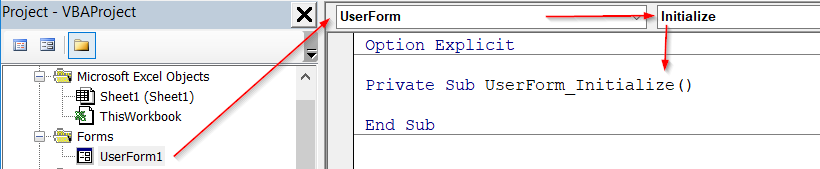 Screenshot showing the selection of the Initialize event in the VBA editor
Step 3: Writing the Population Code
Now we need to write the script that iterates through the spreadsheet cells and adds them to the Combobox. In this example, our source data is located in Sheet1, specifically in the range F2:F10.
We will use a For Each loop. This method is robust because it treats the range as a collection of objects (cells). For every cell in the specified range, the code grabs the value and uses the .AddItem method to push it into the Combobox.
Refer to the code structure in the image below. Note how we declare a variable a to represent each cell in the range.
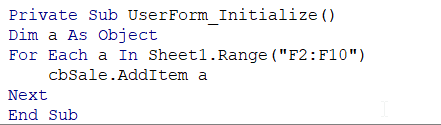 VBA code snippet demonstrating how to loop through a range and add items to a Combobox
Step 4: Execution and Testing
After pasting or writing the code, it is time to verify the functionality. Press F5 or click the green “Run” button in the toolbar to launch UserForm1.
Click on the “Sales Staff” dropdown arrow. You should see the names from your spreadsheet populated perfectly in the list. If you update the data in cells F2:F10 and reopen the form, the list will update automatically.
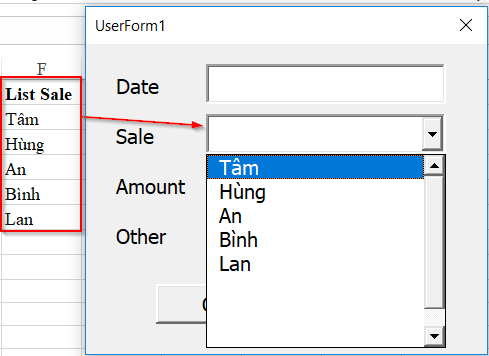 The final result showing the UserForm with a fully populated dropdown list
Conclusion
Populating a Combobox in Excel VBA is a fundamental skill that significantly enhances the usability of your custom tools. By moving away from hard-coded lists inside the VBA editor and instead referencing worksheet ranges, you make your applications more dynamic and easier to maintain.
Whether you are building a simple data entry form or a complex inventory management system, mastering the UserForm_Initialize event and the .AddItem method is the first step toward professional Excel development. We encourage you to experiment further by using dynamic named ranges to handle lists that grow or shrink in size automatically.
References
- Microsoft Learn: UserForm Object (VBA)
- Excel VBA Documentation: ComboBox Control
- Tech Community: Excel VBA Best Practices for User Interface Design.












Discussion about this post