


In the world of data analysis, raw data is rarely perfect. It often comes messy, containing unnecessary prefixes, suffixes, or embedded codes that need to be cleaned before analysis can begin. While basic Excel users rely on manual deletion, professionals know that the true power of data cleaning lies in formulas.
Functions like LEFT, MID, RIGHT, LEN, and SEARCH are useful individually, but their real potential is unlocked when combined. This guide will take a deep dive into advanced text manipulation techniques, demonstrating how to nest these functions to filter and remove unwanted characters dynamically and efficiently.
Removing Leading Characters: The Dynamic “Right” Approach
A common scenario in data processing is the need to strip away the beginning of a text string to extract a specific value at the end. For example, consider a list of website URLs where you need to extract the domain extension (the part after the first dot), but the length of the subdomain varies (e.g., “www” vs “blog”).
 Excel spreadsheet showing a column of domain names requiring second-level domain extraction
Since the number of characters before the first dot is not fixed, you cannot simply hardcode a number into the RIGHT function. Instead, you must calculate the length dynamically.
The Logic Behind the Formula
To extract the text after a specific delimiter (in this case, the dot “.”), we need to tell Excel exactly how many characters to pull from the right side of the string. The logic is as follows:
- Calculate Total Length: Use
LEN(cell)to count the total characters. - Find the Delimiter: Use
SEARCH(".", cell)to find the position number of the first dot. - Calculate Characters to Keep: Subtract the position of the dot from the total length.
Step-by-Step Implementation
The formula combines these steps into a single, elegant solution. By nesting SEARCH and LEN inside RIGHT, we create a dynamic filter that adjusts to every cell.
 Screen capture of Excel showing the result of the RIGHT, LEN, and SEARCH formula combination
The Syntax:
=RIGHT(A2, LEN(A2) - SEARCH(".", A2))Here is a breakdown of how Excel processes this:
SEARCH(".", A2): Returns the position of the first period.LEN(A2): Returns the total character count of the text string.LEN - SEARCH: Mathematical operation to determine the exact length of the remaining substring.
 Animated GIF demonstrating the process of dragging the formula down to apply to multiple cells
This method is far superior to using Fixed Width text-to-columns features because it remains live. If the source data changes, the cleaned data updates automatically. While this example uses a dot, you can replace . with any delimiter, such as a hyphen, space, or special character, to suit your specific dataset.
Removing Trailing Characters: The Dynamic “Left” Approach
Conversely, you may encounter situations where the valuable data is at the beginning of the string, and you need to discard variable-length “garbage” data at the end.
Consider a dataset of Product IDs where the product name is followed by a manufacturing year (e.g., “2018”). The product names have different lengths, so a static LEFT function will not work.
 Excel table showing product IDs mixed with year numbers
The Calculation Strategy
To isolate the product name, we need to extract everything to the left of the specific marker (in this case, the year “2018”).
The formula relies on finding the starting position of the unwanted text and stopping exactly one character before it.
- Identify the Marker: We use
SEARCH("2018", A2). - Adjust the Position: Since
SEARCHgives the position of the first digit of “2018”, we must subtract 1 to ensure we don’t include that digit.
The Syntax:
=LEFT(A2, SEARCH("2018", A2) - 1)By applying this formula, Excel scans the string, locates the specific delimiter, and extracts only the text preceding it.
 Excel sheet displaying the clean list of product names after removing the trailing year
This technique is particularly useful for cleaning exported database reports where ID numbers are often concatenated with timestamps or status codes.
Removing Characters from the Middle: The “Split and Join” Technique
The most complex text manipulation task is removing a substring from the middle of a cell while keeping the beginning and end intact. The MID function is great for extracting middle text, but to remove it, we actually need to combine LEFT, RIGHT, and the ampersand (&) operator.
Let’s look at a scenario where a date string (Year-Month-Day) is embedded in the middle of a Product ID, and we need to remove it to reconstruct the clean ID.
 Data column showing complex text strings containing dates that need removal
Constructing the Algorithm
In this example, we need to remove the 8 characters representing the date (YYYYMMDD) that appear after a specific marker.
The Strategy:
- Extract the Left Part: Get all characters up to the start of the unwanted string.
- Extract the Right Part: Get all characters appearing after the unwanted string.
- Concatenate: Join Part 1 and Part 2 together.
Step 1: The Left Side
We use LEFT based on the position of the marker (e.g., “2018”).
=LEFT(A2, SEARCH("2018", A2) - 1)
Step 2: The Right Side
This is the tricky part. We need to start extracting from the position after the date ends.
=RIGHT(A2, LEN(A2) - (SEARCH("2018", A2) + 8 - 1))
Note: The number 8 represents the length of the text we are removing.
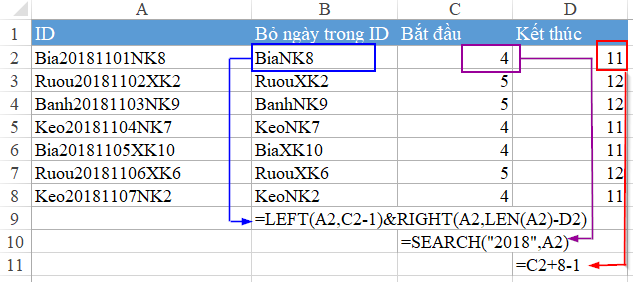 Table showing the final cleaned IDs after removing the middle value
The Combined Formula
To achieve the result in a single cell, we combine the two logic blocks using the & operator. This effectively “stitches” the front and back of the string together, skipping the middle section entirely.
Final Syntax:
=LEFT(A2, SEARCH("2018",A2)-1) & RIGHT(A2, LEN(A2) - (SEARCH("2018",A2) + 7))This approach provides a clean, seamless ID without the interfering date code.
 Screenshot of the full formula bar illustrating the combination of LEFT and RIGHT functions
Conclusion
Mastering Excel’s text functions requires moving beyond simple, single-function formulas. As demonstrated, the real magic happens when you combine logical operators with text extraction tools.
By understanding how to nest SEARCH within LEFT and RIGHT, and utilizing LEN to handle variable string lengths, you can automate complex data cleaning tasks that would otherwise take hours of manual work. Whether you are filtering domains, cleaning product codes, or restructuring messy exports, these logic patterns are essential tools for any data professional.
References
- Microsoft Support: Text functions (reference).
- TechCrunch: Enterprise software trends.
- ExcelJet: Advanced formula nesting techniques.










Discussion about this post