


Cleaning data is one of the most common tasks for anyone working with spreadsheets. Whether you are dealing with imported databases, customer lists, or product codes, you will often encounter text strings cluttered with unwanted prefixes, suffixes, or separators. Knowing how to efficiently strip these characters is essential for maintaining clean and usable data.
In this guide, “Thủ Thuật” will walk you through the most effective methods to remove specific characters in Excel. We will explore precision techniques using formulas and bulk-editing tricks using the Find and Replace feature.
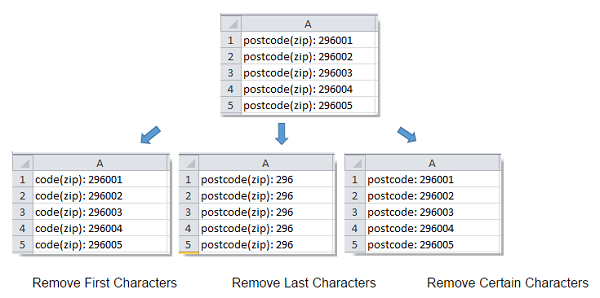 Excel dialog box launcher interface
Method 1: Using Excel Formulas for Precision
When you need to remove a set number of characters from the beginning or end of a text string, Excel functions are your best friend. Specifically, the combination of LEFT or RIGHT functions with the LEN function provides a dynamic way to clean your data.
Removing Characters from the Beginning
To remove characters from the start of a cell (the left side), we actually want to keep the characters on the right. Therefore, we use the RIGHT function.
Step 1: Understand the Logic
You cannot simply tell Excel to “delete.” Instead, you tell it what to extract. The logic is: “Extract the characters from the right, calculated by the total length minus the number of characters you want to remove.”
Step 2: Enter the Formula
Assume your data is in cell A1 and you want to remove the first 4 characters. Click on cell B1 and enter the following formula:
=RIGHT(A1, LEN(A1)-4)
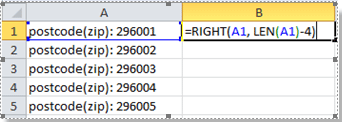 Excel formula to remove first four characters using RIGHT and LEN
How it works:
LEN(A1)counts the total number of characters in the cell.-4subtracts the characters you wish to discard.RIGHT(...)extracts the remaining characters starting from the end of the string.
You can customize the number “4” to match the specific length of the prefix or code you are trying to eliminate.
 Animated demonstration of applying Excel formula to a column
Step 3: Copy the Formula
Once the formula is working in the first cell, use the Fill Handle (the small square at the bottom-right corner of the cell) and drag it down to apply the change to your entire column.
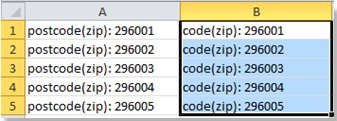 Spreadsheet showing text strings with the first four characters removed
Removing Characters from the End
The process is similar if you need to remove characters from the end of a string. In this case, you want to keep the left side, so you use the LEFT function.
For example, to remove the last 3 characters from cell A1, use:
=LEFT(A1, LEN(A1)-3)
While formulas are excellent for fixed-length removals, they can become complicated if the characters you want to remove are in the middle of the text or vary in length. For those scenarios, the next method is often faster and easier.
Method 2: Using “Find and Replace” with Wildcards
The “Find and Replace” tool in Excel is not just for swapping simple words. By utilizing wildcards, you can transform it into a powerful data cleaning tool. This is particularly useful when you want to remove text based on a specific separator (like a colon, hyphen, or comma) rather than a fixed position.
Removing Text After a Specific Character
Scenario: You have a list of data where you want to keep the label but remove the description following a colon (e.g., “Name: John Doe” -> “Name”).
- Open the Dialog: Press
Ctrl + Hon your keyboard to open the Find and Replace window. - Set the Pattern: In the “Find what” box, enter the separator followed by an asterisk. For example:
: *- The colon (
:) identifies the starting point. - The asterisk (
*) is a wildcard representing all characters that follow.
- The colon (
- Clear the Replacement: Leave the “Replace with” box completely empty.
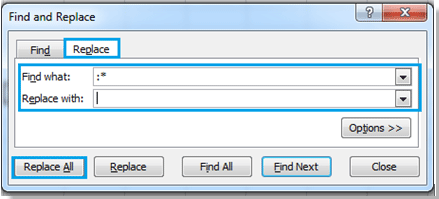 Find and Replace dialog box with wildcard syntax
- Execute: Click “Replace All”. Excel will find the colon and everything after it, then replace it with nothing—effectively deleting it.
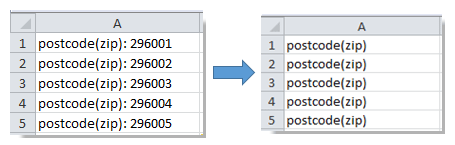 Excel sheet showing data with text removed after a colon separator
Removing Text Before a Specific Character
Conversely, you might want to remove the label and keep only the data (e.g., “Name: John Doe” -> ” John Doe”).
- Open Find and Replace (
Ctrl + H). - In the “Find what” box, enter the asterisk followed by the separator:
*:- This tells Excel to find everything up to and including the colon.
- Leave “Replace with” empty.
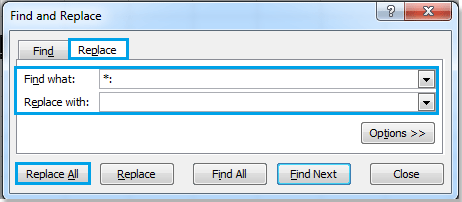 Find and Replace settings to remove text before a specific character
- Click “Replace All”. The prefix and the separator will vanish, leaving only the desired data.
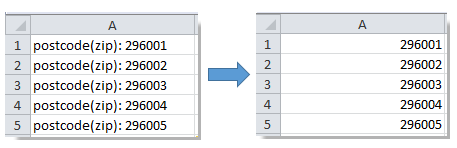 Final data set with prefixes removed using Find and Replace
Important Note: This method permanently alters your data. It is highly recommended to work on a copy of your column or backup your sheet before performing a “Replace All” operation with wildcards.
Elevating Your Excel Skills
Mastering data manipulation is just the first step in becoming proficient with spreadsheets. To truly leverage the power of Excel for data analysis and reporting, consider expanding your knowledge in the following areas:
- Logical and Summary Functions: Master
SUMIF,COUNTIF, and their plural counterparts (SUMIFS,COUNTIFS) to analyze conditional data. - Lookup Functions: Move beyond VLOOKUP by learning
INDEXandMATCH, or the modernXLOOKUP. - Data Visualization: Learn to use Conditional Formatting to highlight trends automatically.
- Advanced Reporting: Dive into Pivot Tables to summarize vast datasets in seconds.
Conclusion
Removing unwanted characters in Excel does not have to be a tedious manual process. By choosing the right tool—formulas for fixed-position edits or Find and Replace for pattern-based cleaning—you can save hours of work and ensure your data is pristine.
We hope this guide helps you streamline your workflow. For more in-depth tutorials and tech tips, continue exploring “Thủ Thuật” to stay ahead in the digital world!
References
- Microsoft Support: Text functions (Reference)
- GCFGlobal: Excel Formulas and Functions
- Thủ Thuật: Tech Tips & Tricks Archive












Discussion about this post