
Proper margin alignment is a fundamental step in ensuring your Microsoft Word documents look professional, are easy to read, and print correctly without cutting off text. Whether you are drafting a thesis, a contract, or a simple report, mastering the Page Setup and margin tools is essential.
This comprehensive guide from Thủ Thuật will walk you through the exact steps to adjust margins in Microsoft Word. These instructions are compatible with a wide range of versions, including Word 2007, 2010, 2013, 2016, 2019, and the latest Office 365 updates.
Accessing Page Setup for Precision Control
To gain full control over your document’s layout, you need to access the Page Setup dialog box. While there are shortcuts, this method offers the most precise customization options for your specific needs.
Step 1: Open your Microsoft Word document.
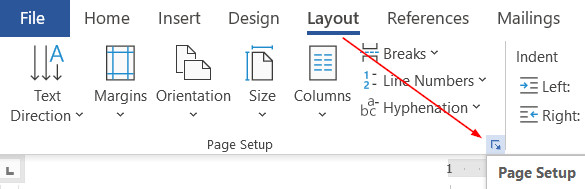
Step 2: Locate and click on the Layout tab on the ribbon toolbar (in some older versions like Word 2007/2010, this may be labeled as Page Layout).
Step 3: Look for the Page Setup group. click the small arrow icon in the bottom-right corner of this group to open the full settings window.
Location of the Page Setup arrow within the Layout tab in Microsoft Word
Once you click this icon, the Page Setup dialog box will appear, serving as the command center for your document’s physical formatting.
Configuring Custom Margins
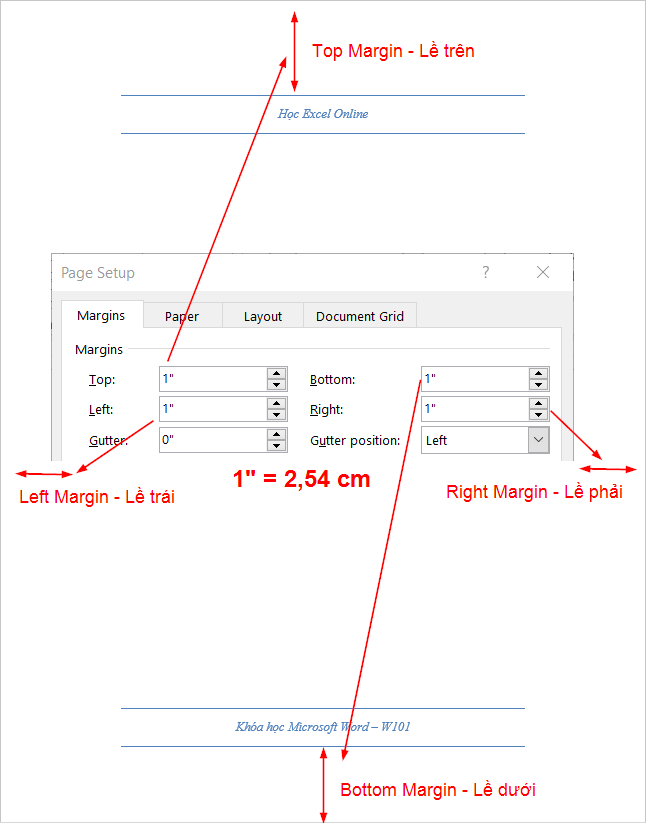
Inside the Page Setup window, the Margins tab is the first section you will see. This is where you manually input the exact distance between the text and the edge of the paper.
The key parameters you need to configure are:
- Top Margin: The space at the header/top of the page.
- Bottom Margin: The space at the footer/bottom of the page.
- Left Margin: The space on the left side (critical for binding).
- Right Margin: The space on the right side.
The Page Setup dialog box showing Top, Bottom, Left, and Right margin settings
Note on Measurement Units:
Word may display units in either Inches (“) or Centimeters (cm) depending on your regional settings. If you are following a specific guideline that uses a different unit, you can easily convert them: 1 inch = 2.54 cm.
Recommended Standard Margins for Printed Documents
While Microsoft Word defaults to 1 inch (2.54 cm) on all sides, this is not always the optimal standard for formal documents, especially those intended for physical binding or filing.
For administrative documents, theses, or formal reports in Vietnam and many academic circles, the following spacing is widely recommended to ensure a balanced look:
- Left Margin: 3 cm (approx. 1.18″)
- Right Margin: 1.5 cm (approx. 0.59″)
- Top Margin: 2 cm (approx. 0.79″)
- Bottom Margin: 2 cm (approx. 0.79″)
Why is the Left Margin wider?
The left margin is intentionally set wider (3 cm vs 1.5 cm) to accommodate the “gutter”—the space consumed by staples, spiral binding, or hole punches. If the left margin is too narrow, text may disappear into the spine of the book or folder, making the document difficult to read.
Utilizing Text Boundaries for Visual Layout Control
When formatting complex documents, it can be difficult to visualize exactly where your typing area ends and the margin begins. Microsoft Word offers a hidden feature called Text Boundaries that draws a dotted line around your content area.
To enable this feature:
- Click the File tab (or the Office Button in Word 2007).
- Select Options at the bottom of the menu.
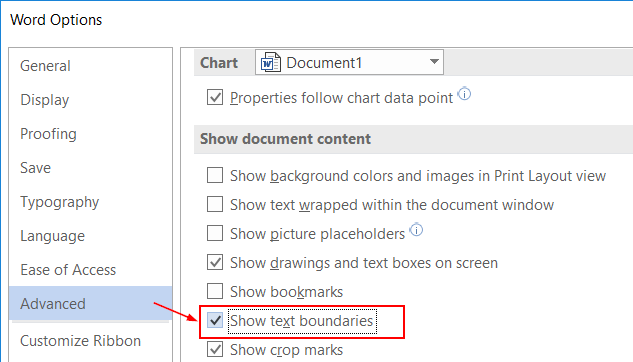
- In the Word Options window, navigate to the Advanced tab.
- Scroll down to the Show document content section.
- Check the box for Show text boundaries.
The Word Options window with the Show text boundaries checkbox selected
Once enabled, you will see dotted lines confining your text. These lines do not print; they are merely visual aids to help you layout images and text paragraphs more accurately within your set margins.
Quick Margin Adjustments Using Presets
If you do not require specific custom measurements, Word provides several built-in presets that allow you to change margins instantly. This is useful for standard letters or maximizing space on a page.
To use presets:
- Go to the Layout tab.
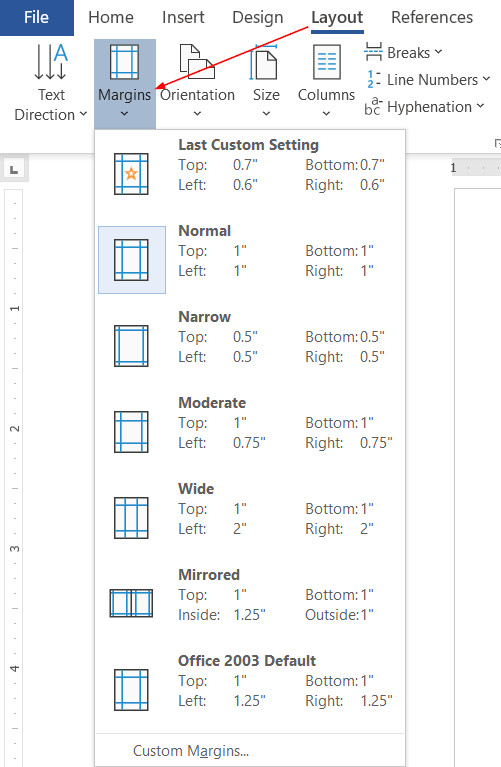
- Click on the Margins button.
- Select a preset from the dropdown menu, such as Normal, Narrow, Moderate, or Wide.
Selecting margin presets from the Layout tab dropdown menu
If none of the presets match your requirements, you can simply click Custom Margins… at the bottom of this menu to return to the detailed Page Setup window discussed earlier.
Conclusion
Adjusting margins is a simple yet critical skill in Microsoft Word that directly impacts the presentation and utility of your document. Whether you are preparing a university dissertation requiring a 3cm binding edge or a simple flyer needing narrow margins, mastering these tools ensures your work always looks its best.
We hope this guide has helped you master document layout. For more productivity tips and Office hacks, continue exploring Thủ Thuật.
Further Reading:
- How to insert and manage page breaks in Word.
- Converting Word documents to PDF without formatting errors.
- Mastering table creation and formatting in Microsoft Word.
References
- Microsoft Support. (n.d.). Change margins. Retrieved from Microsoft.com.
- GCFGlobal. (n.d.). Word: Page Layout. Retrieved from GCFGlobal.org.
![[Complete Guide] How to Adjust Margins in Word for Professional Documents [Complete Guide] How to Adjust Margins in Word for Professional Documents](https://thuthuat.com.vn/wp-content/uploads/2025/04/Huong-dan-chi-tiet-cach-can-le-trong-Word-2010-2013-2016.jpg)


Discussion about this post