
Do you often find yourself struggling to convert measurements in your spreadsheets? whether you are changing centimeters to inches, meters to centimeters, or handling complex engineering data, unit conversion is a frequent necessity. While you could reach for a calculator, Microsoft Excel offers built-in solutions to handle these tasks efficiently.
This guide explores the two primary methods for converting units in Excel: standard mathematical formulas and the powerful CONVERT function. We will break down the syntax and provide step-by-step examples to help you optimize your workflow.
Method 1: Using Mathematical Formulas
The most basic way to convert units in Excel is by applying standard arithmetic operators. This method relies on knowing the specific conversion factor between two units (e.g., knowing that 1 meter equals 100 centimeters).
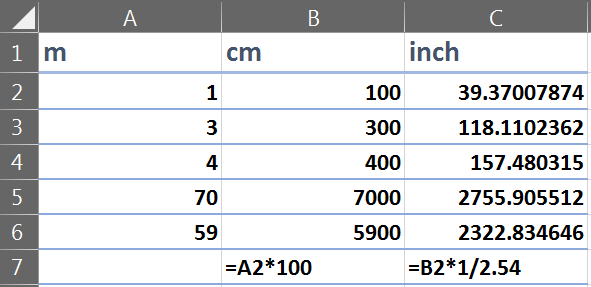
This approach involves multiplying or dividing the cell value by the conversion constant. For instance, to convert meters to centimeters, you multiply by 100. Conversely, to convert centimeters to inches, you divide by 2.54 (since 1 inch = 2.54 cm).
Spreadsheet showing manual multiplication formulas for unit conversion
Step-by-step example:
- Meters to Centimeters: To convert the value in cell A2, click on cell B2 and enter the formula:
=A2*100. - Centimeters to Inches: To convert the resulting value in B2 into inches, click on cell C2 and enter:
=B2*1/2.54(or=B2/2.54). - Apply to All: Use the Fill Handle (the small square at the bottom-right of the active cell) to drag the formula down to other rows.
While effective for simple tasks, this method has limitations. It requires you to memorize exact conversion rates, which increases the risk of human error if the rate is recalled incorrectly.
Method 2: Using the CONVERT Function
For a more professional and accurate approach, Excel provides the CONVERT function. This built-in tool eliminates the need to memorize conversion factors and supports a vast array of measurement categories including weight, distance, time, pressure, and temperature.
Understanding the Syntax
The structure of the function is straightforward:
=CONVERT(number, from_unit, to_unit)Parameters explained:
- number: The numeric value you want to convert or the cell reference containing that value.
- from_unit: The text abbreviation of the current unit (e.g., “m” for meters).
- to_unit: The text abbreviation of the unit you want to convert to (e.g., “in” for inches).
When you begin typing the formula, Excel’s IntelliSense will automatically display a list of valid unit codes, making it easier to select the correct one without guessing.
Animation showing the syntax of the CONVERT function in Excel
Practical Application
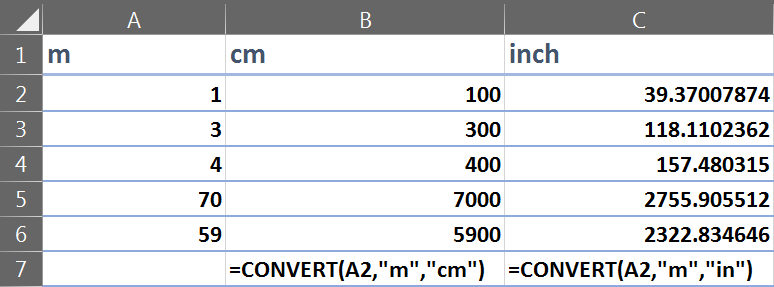
Let’s apply this function to the previous example to see how it simplifies the process.
Step-by-step example:
- Meters to Centimeters: In cell B2, enter the formula:
=CONVERT(A2, "m", "cm") - Meters to Inches: If you want to convert directly from meters to inches in cell C2, enter:
=CONVERT(A2, "m", "in") - Auto-Fill: Drag the formula down using the Fill Handle to convert the rest of your data.
Excel spreadsheet demonstrating the CONVERT function results
Common Unit Codes
To use CONVERT effectively, familiarity with Excel’s unit abbreviations is helpful. Here are a few common ones:
- Distance: “m” (Meter), “in” (Inch), “ft” (Foot), “yd” (Yard), “mi” (Mile).
- Weight: “g” (Gram), “kg” (Kilogram), “lbm” (Pound mass), “ozm” (Ounce mass).
- Time: “yr” (Year), “day” (Day), “hr” (Hour), “mn” (Minute), “sec” (Second).
Pro Tip: If you enter a unit that Excel does not recognize, or if you try to convert incompatible units (like distance to weight), the function will return an #N/A error. Always ensure your unit strings are enclosed in double quotation marks.
Conclusion
Mastering unit conversion in Excel significantly enhances data accuracy and productivity. While manual mathematical formulas are suitable for quick, one-off calculations, the CONVERT function is the superior choice for professional environments. It reduces the margin for error and handles complex conversions with ease.
We recommend using the CONVERT function for its flexibility and reliability. If you found this guide helpful, feel free to leave a comment below or share it with your colleagues. Stay tuned to “Thủ Thuật” for more expert Excel tips and technology insights!


Discussion about this post