

Excel is a powerhouse tool for data analysis, but nothing halts a workflow faster than seeing a cryptic error code pop up in your spreadsheet. Whether you are a financial analyst or a student managing a budget, encountering return values starting with a hash symbol (#)—such as #VALUE!, #REF!, or #NUM!—is a universal experience.
These error codes are not just annoyances; they are Excel’s way of communicating exactly what went wrong during a calculation. Understanding the “language” of these errors is the key to debugging spreadsheets quickly and maintaining data integrity.
Before diving into complex formula errors, let’s address a visual glitch that often panics new users: the series of hash marks (#####). If you see a cell filled entirely with hash marks after applying a formula or formatting a number, do not worry—your data is safe. This simply means the column is too narrow to display the full content.
To resolve this instantly, navigate to Home > Format > AutoFit Column Width, or simply double-click the right border of the column header.
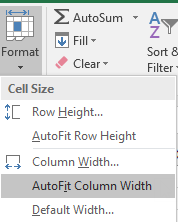 Adjusting column width in Excel to reveal hidden data
Decoding Common Excel Formula Errors
Each error code in Excel points to a specific logical or structural problem. Below is a comprehensive guide to the most frequent errors, why they happen, and how to fix them efficiently.
1. #NUM! Error (Number Error)
The #NUM! error indicates a problem with a number in your formula. This usually happens when a calculation results in a value that is mathematically impossible or exceeds Excel’s processing capabilities.
Common Causes:
- Invalid Numeric Arguments: You might be trying to calculate the square root of a negative number using
SQRT, which is mathematically invalid in the real number system. - Value Limits: The result of the calculation is too large or too small for Excel to handle. Excel supports numbers between approximately -1^308 and 1^308.
- Iterative Functions: Functions like
IRRorRATEmay fail to find a result within the default number of iterations.
How to Fix:
Check your inputs to ensure they are mathematically valid. If you are using iterative functions, you may need to adjust the settings in File > Options > Formulas to increase the maximum iterations.
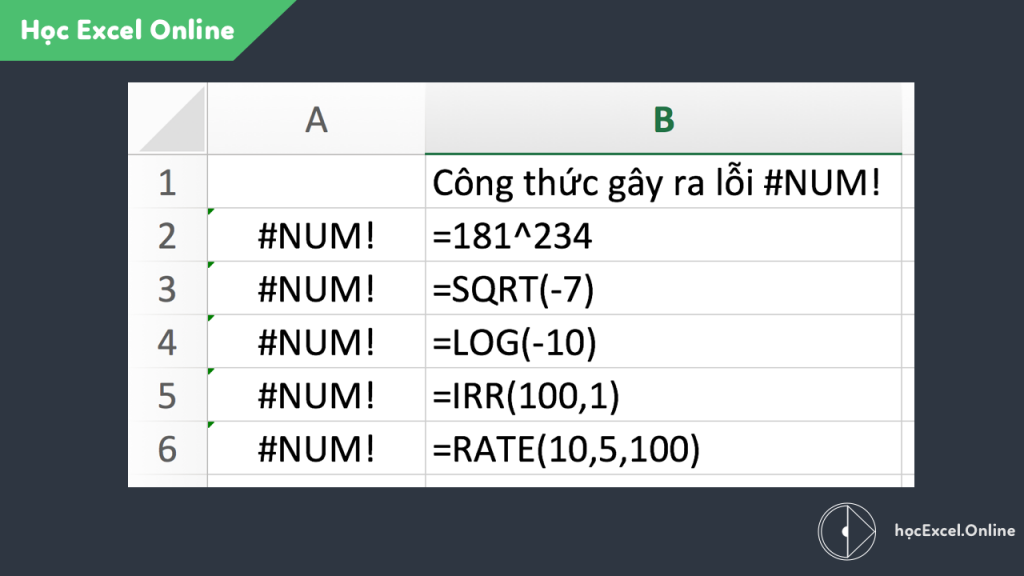 Troubleshooting the #NUM! error in Excel spreadsheets
2. #VALUE! Error (Wrong Data Type)
The #VALUE! error is perhaps the most common stumbling block. It essentially means, “There is something wrong with the way your formula is typed, or the cells you are referencing contain the wrong type of data.”
Common Causes:
- Doing Math with Text: You are trying to add, subtract, or multiply cells that contain text instead of numbers. Even a stray space in a “blank” cell can be interpreted as text.
- Array Formula Issues: You might be pressing just
Enterinstead ofCtrl + Shift + Enterfor an array formula (in older Excel versions).
How to Fix:
Trace the cells referenced in your formula. Ensure that cells intended for calculation contain actual numbers. You can use the ISTEXT function to check suspicious cells. If you need to sum a range that mixes text and numbers, use the SUM function (which ignores text) rather than the plus operator (+).
 Demonstration of the #VALUE! error when mixing text and numbers
3. #N/A Error (Value Not Available)
The #N/A error stands for “Not Available” or “No Value Available.” It is the hallmark of lookup functions like VLOOKUP, HLOOKUP, MATCH, or INDEX.
Common Causes:
- Missing Data: The value you are searching for does not exist in the lookup array.
- Data Mismatch: The lookup value and the source data might look the same but are different formats (e.g., “123” stored as text vs. 123 stored as a number).
- Approximate Match: Using the wrong range_lookup argument (TRUE instead of FALSE) in unsorted data.
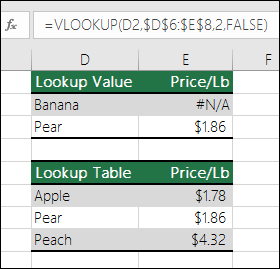 Correcting the #N/A error in Excel lookup functions
Pro Tip: Instead of leaving ugly #N/A errors in your report, wrap your formula in an IFNA or IFERROR function. For example: =IFNA(VLOOKUP(...), "Not Found"). This creates a cleaner, more professional user experience.
4. #DIV/0! Error (Divide by Zero)
As the name suggests, #DIV/0! occurs when you attempt to divide a number by zero. In mathematics, this is an undefined operation, and Excel treats it as an immediate error.
Common Causes:
- Empty Cells: A formula is dividing by a cell that is blank (which Excel treats as zero).
- Explicit Zero: The denominator cell explicitly contains the number 0.
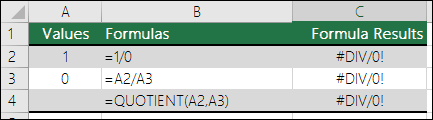 The #DIV/0! error occurring during division operations
How to Fix:
Always ensure your divisor is not zero. You can use the IF function to prevent the calculation if the denominator is 0: =IF(B2=0, "", A2/B2).
5. #REF! Error (Invalid Reference)
The #REF! error is arguably the most problematic because it often signifies that data has been permanently deleted or moved incorrectly. It stands for “Reference Invalid.”
Here are the specific scenarios where #REF! appears:
A. Deleting Rows or Columns Referenced in Formulas
If you have a formula like =A1+B1 and you delete column B, Excel no longer knows where to look for the second part of the equation.
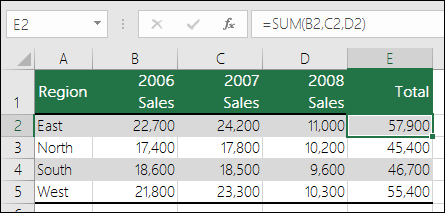 The #REF! error caused by deleting a referenced column
Once the column is deleted, the formula breaks instantly because the coordinate it relied upon is gone.
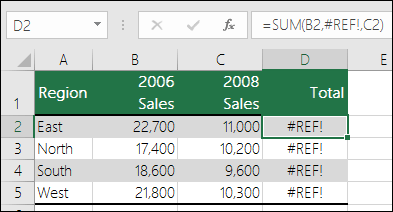 The result of a formula after the referenced column is deleted
Fix: Immediately press Ctrl + Z (Undo) if you accidentally delete a referenced column. To prevent this, consider using range references like =SUM(A1:C1) which are more resilient to deletions within the range.
B. Incorrect VLOOKUP Column Index
In VLOOKUP, the col_index_num argument specifies which column to return data from. If your table array has 4 columns, but you ask VLOOKUP to return data from column 5, you will get a #REF! error.
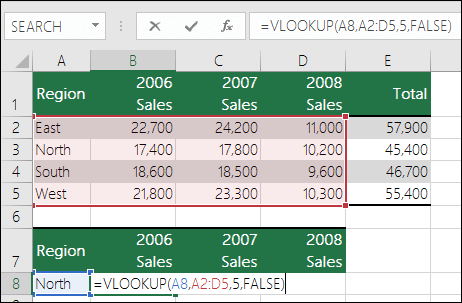 Troubleshooting #REF! error in VLOOKUP formula
Fix: Verify the size of your table array and ensure the column index number is within valid bounds.
C. INDEX Function Out of Bounds
Similar to VLOOKUP, the INDEX function uses row and column numbers to pinpoint a value. If you request Row 10 in a range that only has 5 rows, Excel returns #REF!.
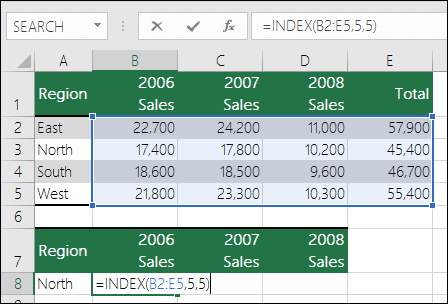 Fixing #REF! error when using the INDEX function
Fix: Check your row_num and column_num arguments to ensure they correspond to the actual dimensions of the selected array.
D. INDIRECT Reference to Closed Workbooks
The INDIRECT function allows for dynamic cell referencing. However, if INDIRECT refers to a different Excel workbook, that workbook must be open. If the external file is closed, the function yields a #REF! error.
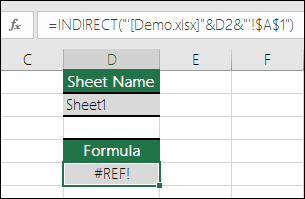 The #REF! error associated with the INDIRECT function and closed workbooks
Fix: Simply open the referenced Excel file, and the formula will recalculate automatically.
6. #NAME? Error (Naming Issues)
The #NAME? error usually indicates a typo or a syntax error. Excel is essentially asking, “What is this name? I don’t recognize it.”
A. Misspelled Function Names
If you type =SUMM(A1:A5) instead of =SUM(A1:A5), Excel looks for a function named “SUMM”, fails to find it, and returns this error.
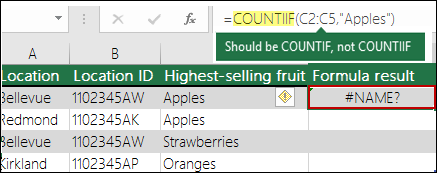 The #NAME? error resulting from a misspelled function name
Fix: Double-check your spelling. As you type, Excel’s autocomplete feature suggests valid function names—click them to avoid typos. You can also use the Function Arguments wizard to insert functions correctly.
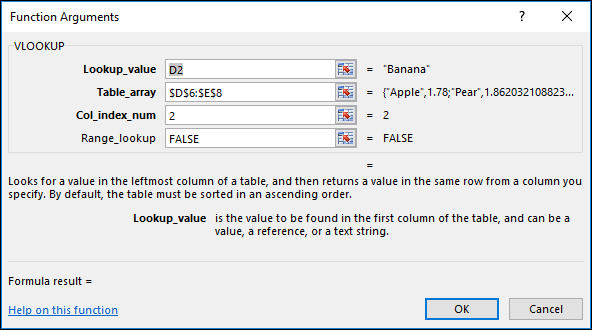 Using the Function Arguments dialog box to avoid syntax errors
B. Undefined or Misspelled Named Ranges
Excel allows you to name ranges (e.g., calling cells A1:A10 “Sales”). If you use a name in a formula that hasn’t been defined yet, or if you misspell a defined name, the #NAME? error appears.
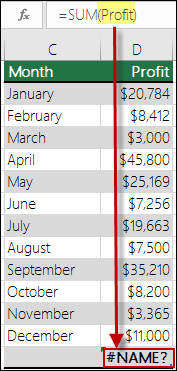 #NAME? error caused by using an undefined range name
Even if the name exists, a simple typo in the formula will break the link.
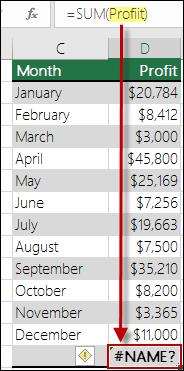 #NAME? error caused by misspelling a defined range name
Fix: Go to the Formulas tab and check the Name Manager to verify the spelling and existence of your named ranges.
C. Missing Quotes in Text Formulas
When writing formulas that include text strings (like combining names), the text must be enclosed in double quotation marks (""). Without them, Excel thinks the text is a function or a named range.
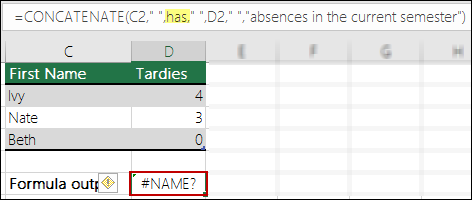 #NAME? error due to missing quotation marks in text strings
Fix: Ensure all text strings are quoted. For example: =LEN("Hello") is correct; =LEN(Hello) will trigger the error.
D. Missing Colons in Range References
If you type =SUM(A1A10) instead of =SUM(A1:A10), Excel does not recognize the range.
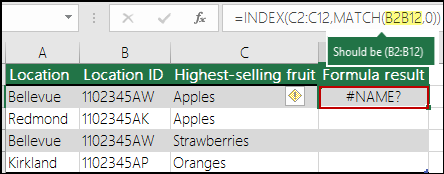 #NAME? error caused by missing colons in cell ranges
Fix: Always separate the start and end of a range with a colon (:).
7. #NULL! Error (Empty Intersection)
The #NULL! error is rare but tricky. It happens when you specify an intersection of two ranges that do not actually intersect. In Excel, a space character is used as the “intersection operator.”
Common Cause:
Using a space instead of a comma (union operator) or colon (range operator). For example, typing =SUM(A1:A5 B1:B5) tells Excel to sum the cells where these two ranges overlap. Since they don’t overlap, the result is null.
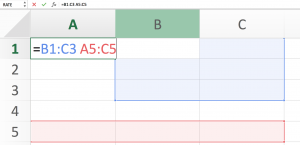 The #NULL! error indicating non-intersecting ranges
Fix: Check your separators. Use a comma (,) or semicolon (;) depending on your region settings to separate multiple arguments, not a space.
Conclusion
Mastering Excel is not just about learning functions; it is about learning how to troubleshoot when things go wrong. By understanding the distinct meanings behind #NUM!, #VALUE!, #REF!, and other errors, you transform from a user who fears error codes into a proficient analyst who can diagnose and fix spreadsheet logic instantly.
Remember, every error is a clue. Use the built-in auditing tools, check your references, and keep your data clean. With these tips, you will ensure your workbooks remain accurate, professional, and reliable.
References
- Microsoft Support: How to correct a #NUM! error.
- Excel Jet: Troubleshooting Excel formula errors.
- TechRepublic: Guide to Excel error codes.
- Official Microsoft Excel Documentation regarding Operator and Precedence.










Discussion about this post