


Using the Alt + Enter shortcut in Excel is a fantastic way to keep data visually organized within a single cell. It allows you to stack information like names, addresses, and cities neatly on top of each other. However, while this looks great for presentation, it creates a significant nightmare for data analysts. When multiple data points are trapped in one cell, you cannot filter, sort, or analyze them effectively.
To solve this, you need to “unpack” that cell. This guide will walk you through the professional method of splitting multi-line cells into separate columns using Excel’s powerful Text to Columns feature and a specific keyboard shortcut that serves as the “magic key.”
 Illustration of a user struggling with multi-line data in Excel
Technically, when you use Alt + Enter, you are inserting a specific character code (ASCII character 10) into the string. To split the data, we must tell Excel to look for this invisible character and use it as the cutting point.
Understanding the Data Structure
Before we dive into the technical steps, let’s look at a common scenario. You might have a dataset where the Full Name, Street Address, and City are all contained in Column B, separated only by line breaks.
 Example of raw data containing name and address in a single cell
Our goal is to parse this information so that each line occupies its own distinct column (e.g., Column C for Names, Column D for Addresses, etc.). This transformation is essential for any advanced data processing or importing tasks in the future.
Step-by-Step Guide: Splitting Cells by Line Breaks
Follow these steps to clean your data efficiently. Ensure that you have empty columns to the right of your data, as this process will overwrite adjacent cells.
1. Select Your Data Range
Begin by highlighting the cells you wish to split. It is crucial to select only the cells containing the data, rather than the entire column, to avoid processing the header row if it doesn’t need splitting.
 User selecting the specific range of cells to be split
2. Access the Text to Columns Tool
Navigate to the Data tab on the Excel Ribbon. Look for the Data Tools group and click on the Text to Columns button. This feature is the industry standard for parsing data without using complex formulas.
 Animation showing the mouse cursor navigating to the Data tab
Once you click the button, the Convert Text to Columns Wizard will launch. This wizard is a three-step process that gives you granular control over how your data is divided.
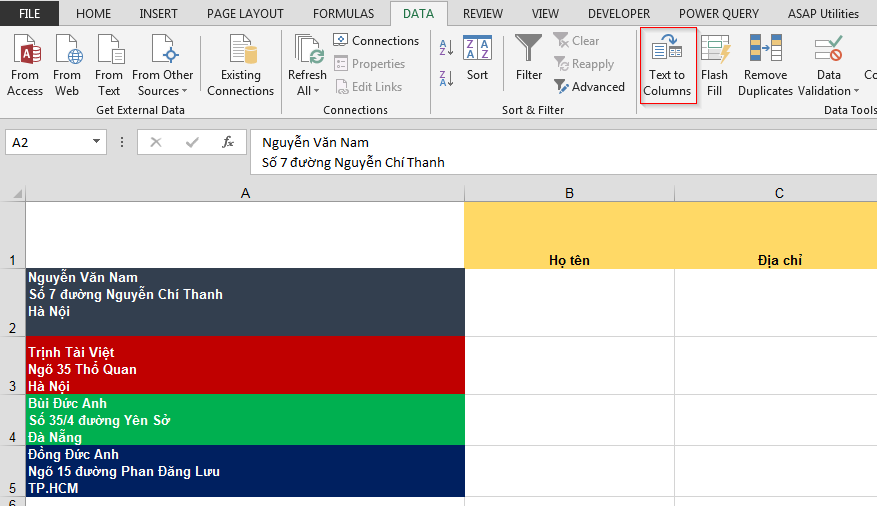 The initial screen of the Convert Text to Columns Wizard
3. Choose the Data Type
In step 1 of the wizard, you will see two options: “Delimited” and “Fixed width”. Since our data is separated by a specific character (the line break) rather than a fixed number of spaces, select Delimited.
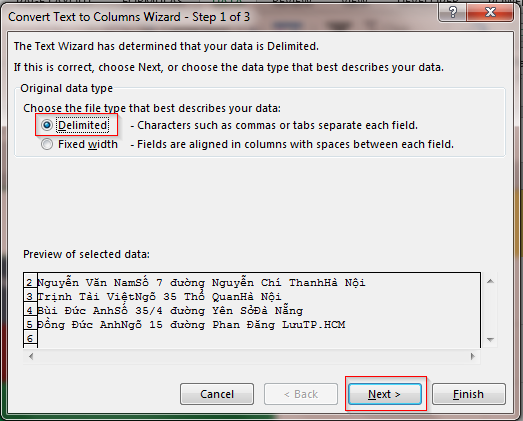 Selecting the Delimited option in the wizard
Click Next to proceed to the most critical part of this tutorial.
4. Set the Delimiter Using Shortcut Keys
In step 2, you tell Excel exactly what separates your data. You will see checkboxes for Tab, Semicolon, Comma, and Space. Uncheck all of these.
Check the box labeled Other. Click inside the small text box next to “Other” and press Ctrl + J on your keyboard. You won’t see a symbol appear, but you might see a tiny blinking dot or the cursor move slightly. This shortcut represents the “Line Feed” character.
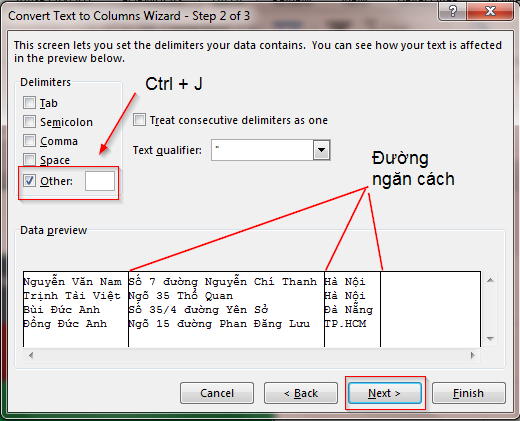 Entering the Ctrl + J shortcut in the Other field
Check the “Data preview” window at the bottom of the wizard. You should now see vertical lines separating your names, addresses, and cities. If you see this, the shortcut worked. Click Next.
5. Define Destination and Format
In the final step, you can format the data columns (usually “General” or “Text” is fine). More importantly, you need to define the Destination. By default, Excel will overwrite your original data. If you want to keep the original column and output the split data next to it, change the destination cell (e.g., change $B$2 to $C$2).
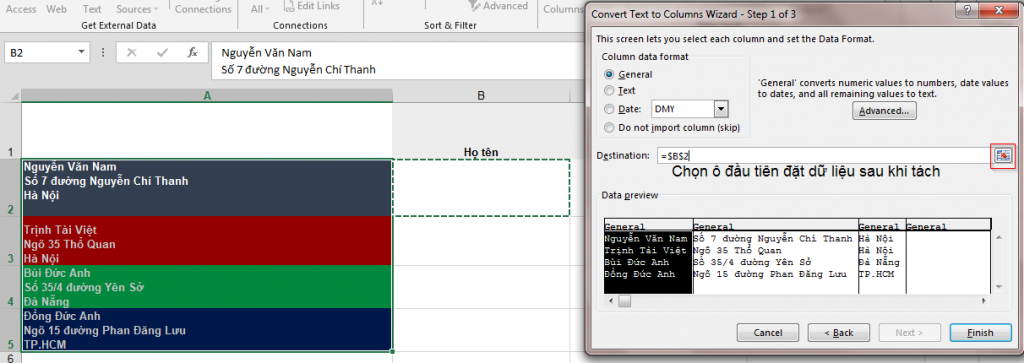 Selecting the destination cell for the split data
Click Finish to execute the command. Excel might ask for confirmation to replace data in destination cells; click OK if you have ensured the space is clear.
The Result
After completing the wizard, your single column of messy, multi-line data will be transformed into organized, separate columns.
 Final result showing data separated into three distinct columns
As seen in the image above, the Name, Address, and City are now in their own fields, ready for sorting or importing into other databases.
Conclusion
Splitting Excel cells based on line breaks using Ctrl + J is a fundamental skill for data cleaning. While Alt + Enter helps with the visual layout of a spreadsheet, mastering the Text to Columns feature ensures you can always convert that layout back into usable, analytical data.
We hope this tutorial helps streamline your workflow. For more advanced Excel techniques and productivity tips, keep following Thủ Thuật to elevate your tech expertise.
References
- Microsoft Support: Distribute the contents of a cell into adjacent columns.
- Excel Functions: Character codes and text manipulation.












Discussion about this post