


Excel is far more than just a digital ledger for storing numbers; it is a powerful logic engine capable of complex data analysis. At the heart of this functionality lies the ability to compare data between cells. Whether you are filtering databases, highlighting outliers, or building dynamic reports, understanding Excel comparison operators (also known as logical or Boolean operators) is fundamental.
These operators allow users to construct logical tests that return either TRUE or FALSE. This guide provides a comprehensive technical breakdown of the six standard comparison operators, their nuances, and how to deploy them effectively in your workflows.
Understanding the Core Comparison Operators
In Microsoft Excel, a comparison operator acts as a mathematical symbol that compares two values. The output of any formula using these operators is strictly Boolean: it will always result in TRUE or FALSE. This binary outcome is crucial because it triggers the logic for advanced functions like IF, AND, OR, and Conditional Formatting.
Below is the technical specification for the six essential operators:
| Operator | Name | Syntax Example | Logical Description |
|---|---|---|---|
| = | Equal to | =A1=B1 | Returns TRUE if the value in A1 is identical to B1. |
| <> | Not equal to | =A1<>B1 | Returns TRUE if A1 differs from B1 (opposites of the Equal operator). |
| > | Greater than | =A1>B1 | Returns TRUE if A1 is strictly larger than B1. |
| < | Less than | =A1<B1 | Returns TRUE if A1 is strictly smaller than B1. |
| >= | Greater than or equal to | =A1>=B1 | Returns TRUE if A1 is larger than or exactly equal to B1. |
| <= | Less than or equal to | =A1<=B1 | Returns TRUE if A1 is smaller than or exactly equal to B1. |
While the table above covers the syntax, the real challenge for data analysts lies in understanding how Excel handles different data types—such as text, dates, and Booleans—when these operators are applied.
Deep Dive: The “Equal To” (=) Operator
The standard Equal sign (=) is the most frequently used operator, yet it possesses complex behaviors depending on the data context. It creates a logical test to verify if two cells contain the same data.
Common use cases include:
- Direct Comparison:
=A1=B1 - Literal String:
=A1="Apple"(Checks if A1 contains the specific text “Apple”). - Boolean Check:
=A1=TRUE(Verifies if a cell contains the logical value TRUE). - Formula Calculation:
=A1=(B1/2)(Compares A1 against the result of a calculation).
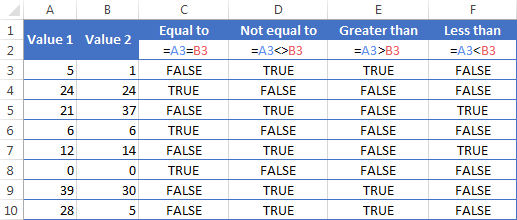 Using logical operators to compare values in Excel spreadsheet
Handling Date Comparisons
Dates in Excel are technically stored as serial numbers (e.g., January 1, 1900, is number 1). However, comparing a cell directly to a text string of a date (e.g., =A1="12/01/2024") often results in errors or false negatives because Excel interprets the text string differently from the stored serial number.
To ensure accuracy when comparing dates using the Equal operator, it is best practice to use the DATEVALUE function or the DATE function to convert the text string into a recognizable serial number.
Formula: =A1=DATEVALUE("12/1/2014")
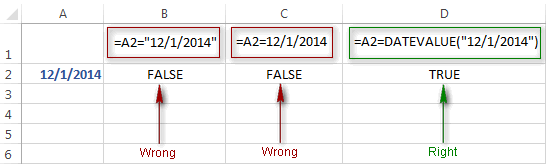 Comparing date values using the DATEVALUE function
Case Sensitivity in Text
A critical technical detail often overlooked is that the standard Equal operator (=) is case-insensitive. To Excel’s standard logic, the string “apple”, “APPLE”, and “Apple” are identical.
If your data validation requires strict case sensitivity (e.g., verifying passwords or case-specific codes), you must bypass the standard operator and use the EXACT function.
Formula: =EXACT(A1, B1)
This function returns TRUE only if the characters and their casing match perfectly.
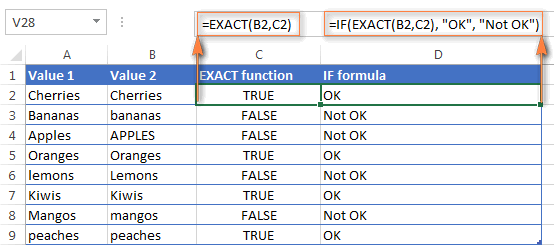 Demonstrating case-sensitive string comparison with EXACT function
Boolean Values vs. Numbers
In standard computing, TRUE is often equated to 1 and FALSE to 0. However, Excel’s comparison operators do not automatically equate the Boolean value TRUE with the number 1. A direct comparison like =A1=1 (where A1 contains TRUE) will return FALSE.
To force Excel to treat a Boolean value as a number for comparison, you must use a “double unary” operator (–) to coerce the data type.
Formula: =--A1=1
This converts the Boolean in A1 into its numeric equivalent before the comparison occurs.
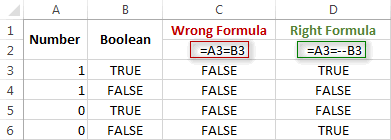 Converting Boolean values to numbers for comparison
The “Not Equal To” (<>) Operator
The <> operator is the logical inverse of the Equal operator. It is particularly useful when filtering out specific values or creating “exception” lists.
For example, if you want to flag all products that are not “Discontinued”, you would use:
=A1<>"Discontinued"
This operator follows the same data type rules as the Equal operator regarding dates and Booleans.
Inequality Operators: Greater Than and Less Than
The operators >, <, >=, and <= form the backbone of numerical analysis. They are indispensable when working with thresholds, such as sales targets, grading systems, or timelines.
- Dates: Later dates are considered “greater” than earlier dates because their serial numbers are higher.
=A1>DATE(2023,1,1)returns TRUE for any date after Jan 1, 2023. - Time: Similar to dates, later times are “greater” than earlier times.
Text Comparison Logic
Many users are surprised to learn that inequality operators work on text as well. Excel compares text strings based on alphabetical order (technically, ASCII/Unicode value order, though case-insensitive by default).
- “B” is greater than “A”.
- “Zebra” is greater than “Apple”.
This logic is helpful when you need to sort data into alphabetical buckets (e.g., Names starting from A-M vs. N-Z).
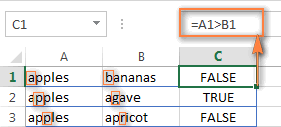 Comparing text strings alphabetically in Excel
Practical Applications in Advanced Functions
Isolating these operators is useful, but their true power is unlocked when nested inside other functions. Here are the three most common applications in a professional environment:
1. The IF Function
The IF function relies entirely on a logical test.
- Syntax:
=IF(logic_test, value_if_true, value_if_false) - Example:
=IF(B2>=500, "Bonus Eligible", "Standard Pay")- Here, Excel uses the
>=operator to determine which text to display.
- Here, Excel uses the
2. Statistical Functions (SUMIF, COUNTIF)
These functions use operators to filter the data they process. Note that when using operators in these functions, they must often be enclosed in quotes.
- Example:
=COUNTIF(D2:D100, ">1000")- This counts cells in the range that strictly exceed the value of 1000.
3. Conditional Formatting
This feature allows you to visually emphasize data based on comparison logic without changing the cell’s content.
- Usage: Highlight all invoices where
Due Date < TODAY(). This uses the “Less Than” operator to visually alert users to overdue items.
Conclusion
Mastering Excel’s comparison operators—Equal, Not Equal, Greater Than, Less Than, and their variations—is a prerequisite for advanced data manipulation. These symbols serve as the building blocks for complex decision-making formulas and automated data analysis.
By understanding nuances like case sensitivity, date serial numbers, and Boolean coercion, you ensure your spreadsheets are not just functional, but technically robust and error-free. We encourage you to experiment with these operators in combination with logical functions to see how they can streamline your reporting.
For more deep dives into technical tutorials and Excel mastery, continue exploring the resources available on Thủ Thuật.
References
- Microsoft Support. “Use comparison operators in Excel formulas.” Microsoft.com.
- Walkenbach, J. (2015). Excel 2016 Bible. Wiley.
- Alexander, M., & Kusleika, R. (2018). Excel 2019 Power Programming with VBA. Wiley.











Discussion about this post